ACER amends the methodology for procuring electricity balancing capacity

Image
Electricity pylons on a green field
Intro News
ACER decided to amend the methodology for the regional procurement of balancing capacity after reviewing ENTSO-E's proposal.

ACER amends the methodology for procuring electricity balancing capacity

What is it about?

In September 2025, ACER received a proposal from the European Network of Transmission System Operators for Electricity (ENTSO-E) to amend the methodology for the regional procurement of balancing capacity. After reviewing the proposal and exchanging with stakeholders, ACER has decided to amend the methodology.

What’s new in the amended methodology?

The methodology for the regional procurement of balancing capacity (first approved by ACER in 2023) enables regional coordination centres (RCCs) to assess how voluntary balancing bids can be utilised effectively across borders. Following this evaluation, RCCs provide transmission system operators (TSOs) with recommendations to reduce the volume of procured balancing capacity, hence utilising the flexibility of the EU electricity system and lowering costs. 

The amended methodology:

  • Updates the reliability parameters used by RCCs to assess the availability of voluntary balancing bids and cross-zonal capacity. This change will foster a more transparent and coordinated process and improve the balancing of the EU power system.
  • Allows RCCs and TSOs to decide on the geographical area where their assessment on the use of voluntary balancing bids will be performed. This will better align the process with the local context and allow for a more effective and coherent practice across Europe. 

What are the next steps? 

RCCs are tasked to assess and provide recommendations on how the use of voluntary balancing bids can be optimised by 19 January 2026.

Interested in learning more about the role of RCCs? Access the latest report on the monitoring of regional coordination centres, published today.

Regional Coordination Centres’ reporting – progress made, more improvements needed

Image
electrical grids
Intro News
Today, ACER publishes its third monitoring report on the reporting obligations of Regional Coordination Centres (RCCs) for 2024, and its new RCC monitoring dashboard.

Regional Coordination Centres’ reporting – progress made, more improvements needed

What is it about?

Today, ACER publishes its third monitoring report on the reporting obligations of Regional Coordination Centres (RCCs) for 2024, and its new RCC monitoring dashboard.

Regional Coordination Centres (RCC) were introduced in 2022 with the Electricity Regulation to facilitate coordination among electricity transmission system operators (TSOs) across regions. They contribute to grid stability, security of supply, and the EU’s energy and climate goals. RCCs are required to report on the outcome of their activities, including:

  • operational performance;
  • coordinated actions;
  • issued recommendations; and
  • designated tasks.

What is in the ACER monitoring report?  

This report covers RCC’s self-reporting efforts in 2024 and, for the first time, more detailed information on 4 tasks requested by ACER: 

  • week-ahead to at least day-ahead adequacy assessments;
  • outage planning coordination;
  • seasonal adequacy assessments;
  • training and certification of RCC staff.

With this dashboard, stakeholders are able to assess implementation progress of RCCs’ tasks and compare the RCCs in Europe. The monitoring will be expanded over time to cover all 16 RCC tasks.

What did ACER monitoring find?  

RCCs continued advancing their activities in 2024. Currently, 7 tasks are in operation across all RCCs:

  • common grid model;
  • short-term adequacy;
  • outage planning coordination;
  • defence and restoration plan consistency;
  • training and certification;
  • post-disturbance analysis; and
  • crisis scenarios.

This compared with 4 tasks in operation for 2023 and none in 2022. ACER welcomes this progress.

However, ACER finds that: 

  • key performance indicators (KPIs) remain difficult to compare across RCCs due to regional differences in the KPI design, and data quality issues;
  • Supporting restoration, the optimisation of inter-TSO settlement, seasonal adequacy assessments, needs for new infrastructure remain at an early stage of development or have not yet been requested by transmission system operators.

In terms of performance, ACER encourages RCCs to:

  • swiftly implement all their tasks and improve data quality;
  • expand capacity calculation and security analysis across different timeframes and regions;
  • focus on improving common grid model results to facilitate long-term readiness;
  • enhance the scope of short-term adequacy, outage planning and training and certification of staff;
  • align key performance indicators (KPIs) across regions; and
  • issue recommendations as well as oversee their implementation. 

In terms of improving their reporting practices, ACER calls on RCCs to: 

  • clearly distinguish between regional processes and pan-European ones;
  • use common criteria and overview tables to present task implementation status; and
  • further explain how the “rotation principle” is applied for pan-European tasks.

What are the next steps?

The next ACER monitoring report is scheduled for December 2026.

ACER intends to expand its monitoring to additional RCC tasks in the future. 

Check out ACER’s new RCC dashboard


Regulators request more time to decide on the minimum activation period of frequency containment reserves providers

Image
Hydroplant dam
Intro News
The Continental Europe Synchronous Area NRAs request a 6-month extension to decide on the minimum activation period of frequency containment reserves providers. ACER will decide by the end of January 2026.

Regulators request more time to decide on the minimum activation period of frequency containment reserves providers

What is it about?

On 3 December 2025, the national regulatory authorities of the Continental Europe Synchronous Area submitted to ACER a joint request for a six-month extension to decide on the transmission system operators’ proposal. This concerns the minimum activation period that frequency containment reserve providers with limited energy reservoirs must ensure in order to remain available during the alert state.

The countries of Continental Europe Synchronous Area are Austria, Belgium, Bulgaria, Croatia, Czechia, Denmark, Estonia, France, Germany, Greece, Hungary, Italy, Latvia, Lithuania, Luxembourg, the Netherlands, Poland, Portugal, Romania, Slovakia, Slovenia and Spain.

What is it about?

EU’s electric power systems operate at the frequency of 50 Hz. Any imbalance between electricity supply and demand causes the frequency to deviate. If not corrected quickly, this can lead to blackouts.

Frequency containment reserve is the first line of automatic response to such deviations. It is activated within seconds to stabilise the frequency and is provided continuously by power-generating or consuming assets (like batteries, hydro plants or demand response systems). 

Some of these providers, especially batteries or demand-side resources, have limited energy reservoirs and can only respond for a short duration. The System Operation Regulation therefore requires a minimum activation time to ensure these resources remain available during the alert state. 

What are the next steps? 

ACER will review the regulators’ joint request and issue its decision by the end of January 2026. 

€11 billion spent EU-wide on fragmented electricity security-of-supply support in 2024

Image
Light bulbs
Intro News
ACER’s 2025 Monitoring Report on security of EU electricity supply looks at whether Europe had adequate electricity supply in 2024, assesses risk preparedness and cross-sectoral interactions and highlights opportunities to improve efficiency.

€11 billion spent EU-wide on fragmented electricity security-of-supply support in 2024

What is it about?

ACER’s 2025 Monitoring Report on security of EU electricity supply looks at whether Europe had adequate electricity supply in 2024, including risk preparedness, cross-sectoral electricity-gas interactions and the total cost of national support measures such as capacity mechanisms and flexibility schemes that help keep the lights on.

What trends did ACER find in 2024? 

  • The EU’s interconnected power system helps keep the lights on.
    • In 2024, power outage levels averaged under two hours per year across the EU, and none were due to inadequate electricity supply.
  • Fragmented support measures come with an annual price tag of €11 billion.
    • Almost €11 billion was spent in 2024 across the EU on a fragmented set of nearly 40 security-of-supply measures.
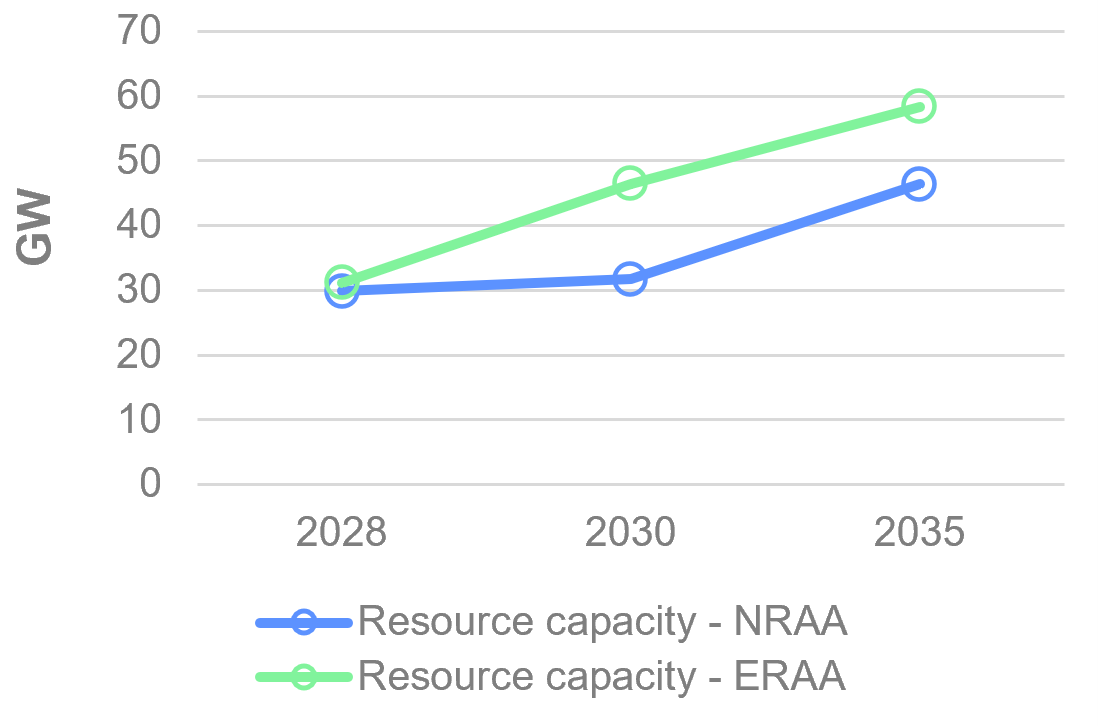
    • Capacity mechanisms are justified if the annual European Resource Adequacy Assessment (ERAA), or alternatively a national assessment, identifies a risk of inadequate supply. Any capacity mechanism must be cleared by the European Commission under State aid rules. These mechanisms rely on a broad range of technologies from dispatchable gas-powered generation to batteries and demand response.
    • Member States can also introduce flexibility measures, again if cleared under EU State aid rules.
  • Capacity mechanisms have yet to become cleaner, gas will still play a role.
    • Only 29% of capacity support was directed to low-emission technologies in 2024, while natural gas will lead in long-term contracts until 2035.
    • Although EU gas demand is expected to fall by 15% by 2035, gas-fired power plants are projected to cover 30% of peak demand.
  • Capacity mechanisms have yet to become more efficient, coordination can help.
    • Capacity auction prices vary more than tenfold across the EU.
    • In 2024, capacity mechanisms cost €6.5 billion (more than double the cost in 2020). Stronger cross-border coordination could reduce additional capacity needs, lowering overall system costs.
    • Limited coordination in Member States’ adoption of capacity and flexibility measures could risk duplication and inefficient investment.
  • Regional and cross-sectoral coordination on risk preparedness remain weak.
    • Only 10% of national risk preparedness plans include joint measures to mitigate the impact of electricity crises and assist neighbouring countries.
    • Cross-sectoral dependencies (i.e. between gas and electricity) are often overlooked.

What are ACER’s recommendations? 

  • Make capacity mechanisms cleaner by removing barriers to distributed energy, enable demand response and disclose how much capacity support goes to fossil-fuels.
  • Make capacity mechanisms more efficient, coordinating capacity planning at EU level and reassessing the design of capacity auctions, particularly in markets with consistently high prices.
  • Integrate flexibility measures into capacity mechanisms or better align them to reduce overlaps and inefficiencies.
  • Strengthen regional cooperation on risk preparedness through exchange of best practices, shared templates and joint implementation monitoring.

More flexibility and faster EU electricity market integration needed to shield consumers from price volatility and support the clean energy transition

Image
Solar and wind generation at sunset
Intro News
ACER’s 2025 electricity Monitoring Report reviews progress in integrating EU electricity markets. It examines forward, day-ahead, intraday and balancing markets, and identifies where rules and projects are delayed.

More flexibility and faster EU electricity market integration needed to shield consumers from price volatility and support the clean energy transition

What is it about?

ACER’s 2025 electricity Monitoring Report reviews progress in integrating EU electricity markets. It examines forward, day-ahead, intraday and balancing markets, and identifies where rules and projects are delayed.

This year’s edition also highlights weather-driven price volatility, which occurs when unusually low renewable generation coincides with higher-than-normal demand due to exceptional weather conditions.

What trends did ACER find in 2024? 

  • EU market integration brings value and helps mitigate high electricity prices.
  • Price volatility shows that more flexibility is needed.
  • Long-term markets remain illiquid, limiting investment signals.
  • Cross-border integration reduces costs, but project delays persist.
  • Balancing integration generated €1.6 billion in welfare gains.
  • Forward markets lack depth; Power Purchase Agreements (PPAs) are growing but vary widely in design.
  • Day-ahead integration is consolidating and intraday markets are evolving.

What are ACER’s recommendations? 

ACER points to several priorities that are key to resilience:

  • Reinforcing flexibility by investing in demand response, storage and backup generation.
  • Accelerating delivery of delayed cross-border projects through timely completion of interconnectors and adoption of flow-based capacity allocation in intraday markets.
  • Broadening transmission system operators' (TSOs') participation in balancing platforms to reduce costs and volatility and ensure more efficient system balancing.
  • Strengthening forward markets with more active long-term trading and well-designed PPAs and Contracts for Difference (CfDs).
  • Moving to flow-based allocation in the intraday timeframe to ensure efficient capacity use and reduce congestion-related costs.
  • Enhancing monitoring and enforcement to ensure rules are applied consistently and consumers benefit.

Check out ACER’s interactive electricity dashboards, with latest data up to Q3 2025. Next update in January 2026.

ACER to review the methodology for electricity redispatching and countertrading cost sharing for the Core region

Image
electricity pylon sharing costs
Intro News
ACER initiates the review of its Decision 30/2020 on the electricity redispatching and countertrading cost sharing methodology for the Core capacity calculation region.

ACER to review the methodology for electricity redispatching and countertrading cost sharing for the Core region

What is it about?

Today, ACER initiates the review of its Decision 30/2020 on the electricity redispatching and countertrading cost sharing methodology for the Core capacity calculation region.  

What is a capacity calculation region?

A capacity calculation region is a set of electrically interdependent bidding zone borders, where capacity calculation, regional operational security, redispatching and countertrading costs sharing tasks are coordinated by that region’s transmission system operators (TSOs).

The Core capacity calculation region involves the TSOs and bidding zone borders of Austria, Belgium, Croatia, Czech Republic, France, Germany, Hungary, Luxembourg, the Netherlands, Poland, Romania, Slovakia and Slovenia. It is the biggest European region, involving 13 Member States, 16 TSOs and 19 bidding zone borders.

What is the methodology about? 

The cost sharing methodology allocates the costs from redispatching and countertrading remedial actions within a capacity calculation region. These actions are triggered to solve network congestions occurring within the region. 

Specifically, this methodology tracks how each action affects congested network elements and assigns the related costs to the responsible TSOs, based on the order of flow types (loop, internal, allocated and power-shifting transformer flows). Loop flows are charged first, however according to the Electricity Regulation, its portion below a given threshold is exempted.

Why amend the methodology?

On foot of the ACER Board of Appeal Decision of 31 July 2025, ACER is now revising its Decision 30/2020 and the methodology accordingly.

What are the next steps?

ACER aims to adopt its Decision by the end of January 2026.

ACER to decide on amending the methodology for procuring electricity balancing capacity

Image
Electricity pylons on a green field
Intro News
ACER received a proposal from the European Network of Transmission System Operators for electricity (ENTSO-E) to amend the methodology for the regional procurement of balancing capacity.

ACER to decide on amending the methodology for procuring electricity balancing capacity

What is it about?

On 26 September 2025, ACER received a proposal from the European Network of Transmission System Operators for Electricity (ENTSO-E) to amend the methodology for the regional procurement of balancing capacity.

What is the methodology about?

Transmission system operators (TSOs) must always keep the power system in balance. TSOs usually procure the balancing capacity needed at national level, but to lower procurement costs, they may opt for utilising available voluntary balancing bids from other countries (e.g. made available when local capacity exceeds national needs).  If transmission capacity is expected to be available across bidding zones during balancing, these bids can also be used to reduce balancing capacity needs. 

The methodology for the regional procurement of balancing capacity enables regional coordination centres (RCCs) to evaluate how voluntary balancing bids can be utilised effectively across borders. Following this evaluation, regional coordination centres provide TSOs with recommendations to reduce the volume of procured balancing capacity, hence utilising the flexibility of the EU electricity system. 

Why amend the methodology?

As requested by ACER, European TSOs propose to update the reliability parameters used by regional coordination centres to assess the availability of cross-zonal capacity and voluntary balancing bids. This is important as reliability parameters need to reflect the most relevant data, enabling TSOs to procure balancing capacity efficiently, and at the same time managing their operational risks. This change should foster a more transparent and coordinated process and improve the balancing of EU power system.

What are the next steps? 

ACER will decide by 5 January 2026.

Interested parties may submit comments or questions to ACER-ELE-2025-009@acer.europa.eu by 31 October 2025.

ACER reiterates its call for stronger transparency in the selection of energy infrastructure projects

Image
Hydrogen and electricity infrastructure
Intro News
ACER publishes its Opinion on the draft lists of proposed Projects of Common Interest (PCIs) and Projects of Mutual Interest (PMIs) for 2025. The PCIs/PMIs lists include energy infrastructure projects prioritised at EU level given their importance.

ACER reiterates its call for stronger transparency in the selection of energy infrastructure projects

What is it about?

Today, ACER publishes its biennial Opinion on the draft lists of proposed projects of common interest (PCIs) and projects of mutual interest (PMIs) for 2025. 

The PCIs/PMIs lists include energy infrastructure projects prioritised at EU level given their impact to significantly enhance the cross-border links among the energy systems of EU countries (and third-party countries in the case of PMIs). These projects can benefit from accelerated permitting procedures, regulatory treatment and funding, as they are identified as key contributors for integrating renewables, boosting cross-border capacity and advancing Europe’s climate and energy goals.

What is the role of ACER?

ACER’s role in the PCIs/PMIs selection process, as defined by the TEN-E Regulation, is to verify that the relevant methodologies and criteria are applied consistently and transparently across regions in the projects’ selection process. A fair and credible process ensures that the most beneficial projects are prioritised in developing trans-European energy infrastructure. ACER’s role is not to give a ‘second opinion’ on the merits of the different projects nor to help decision makers rank such projects for ultimate selection.

What are the key conclusions?

In its Opinion, ACER found:

  • Delays in the availability of Ten-Year Network Development Plans (TYNDPs) data and their cost-benefit results, which hindered the projects’ assessment.
  • Infrastructure needs have been identified only per Member State, without sufficient identification of capacity needs per border.
  • Unclear distinction of monetised and non-monetised benefits in the ranking of projects, reducing clarity on how these are prioritised.
  • Lack of justifications of the projects added on top of the formal proposals from the Regional Groups. The Regional Groups are chaired by the European Commission and include representatives from Member States, transmission system operators, project promoters, energy regulators and ACER. Their role is to assess the projects' potential contribution to EU energy priorities.
  • Difficulty for regulators, due to insufficient data, to properly assess several hydrogen project candidates, including their underlying benefits, in the lists. 
  • The draft PCIs/PMIs lists do not clearly distinguish between mature and less mature electricity projects.

As these obstacles may affect the credibility and robustness of the selection process, ACER recommends to:

  • Deliver the TYNDP data on time and in good quality for the PCIs/PMIs selection process.
  • Introduce an assessment of capacity needs per border per each energy vector, thus improving the needs assessment methodology.
  • Clearly distinguish between projects’ monetised and non-monetised benefits.
  • Ensure greater transparency in complementary project evaluations, if these can’t be avoided.
  • Ensure that the complete set of project data is made available for the national regulatory authorities’ assessment in due time, to allow them to conduct thorough and consistent analyses.
  • Introduce maturity criteria for electricity projects to clearly distinguish between mature and less mature projects on the electricity PCIs/PMIs lists. This would ensure transparent prioritisation and allow support for less mature projects when they are ready for construction.
  • Consider multiple scenarios, in line with ACER’s Scenario Guidelines, to test the robustness of results.

What are the next steps?

By addressing these issues, the PCIs/PMIs selection process will become more transparent, consistent and credible, ensuring Europe invests in the right infrastructure to meet its energy and climate goals.

ACER amends the harmonised allocation rules for long-term electricity transmission rights

Image
Electricity pylons
Intro News
On 27 March 2025, ACER received the transmission system operators’ (TSOs’) proposal to amend the harmonised allocation rules (HAR) for long-term electricity transmission rights. ACER approves the TSOs proposal.

ACER amends the harmonised allocation rules for long-term electricity transmission rights

What is it about?

On 27 March 2025, ACER received the transmission system operators’ (TSOs’) proposal to amend the harmonised allocation rules (HAR) for long-term electricity transmission rights.

The harmonised allocation rules apply to all long-term transmission rights allocations conducted within the European Union, specifying criteria for their auctioning (including use and curtailment of long-term transmission rights, eligibility criteria, etc.). 

The TSOs’ proposal included various updates related to arrangements with market participants, reflecting upcoming market changes (e.g. introduction of 15-minute market time unit in the day-ahead electricity market) and recent incidents (e.g. single day-ahead market decoupling in June 2024). 

To take an informed decision, ACER consulted stakeholders during Spring 2025.

What did ACER decide?

ACER approves the TSOs' proposal, while adding some clarifications and proposing further reviews on the:

  • Usage of the day-ahead price for remunerating long-term transmission rights in case of decoupling: ACER recommends TSOs and national regulatory authorities to review the arrangements among nominated electricity market operators (NEMOs), which should set transparent rules for defining the single day-ahead reference price in case of decoupling. 
  • Relevant rules for the nomination of physical transmission rights: ACER recommends TSOs and national regulatory authorities to review the applicable nomination rules, considering the introduction of 15-minute market time unit in the day-ahead market.

ACER agreed with TSOs to tackle improvements to the collateral requirements in long-term flow-based auctions separately. 

What are the next steps? 

TSOs and regulatory authorities should now review nomination rules and multiple NEMOs' arrangements to reflect the latest updates introduced by ACER. 

ACER proposes improvements to the European grids legal framework

Image
Electricity transmission tower
Intro News
Ahead of the European Commission’s Grids Package proposals (expected in Q4 2025), ACER sets out its recommendations for revising the current legal framework for grids.

ACER proposes improvements to the European grids legal framework

What is it about?

Ahead of the European Commission’s Grids Package proposals (expected in Q4 2025), ACER sets out its recommendations for revising the current legal framework for grids.

Europe’s power grids need to be upgraded, expanded and optimised to connect more planned renewables and thus speed up a cost-efficient clean energy transition.

The European Commission estimated that investment needs for electricity grids will amount to €730 billion for distribution and €477 billion for transmission by 2040.

The European Commission is developing a Grids Package to improve and simplify the current legal framework. This includes the revision and simplification of the 2022 Trans-European Energy Networks Regulation (TEN-E Regulation), a key framework for European energy infrastructure development.

ACER's recommendations address network development aspects (rather than permitting or financing) to improve the efficiency of the EU network planning process and support a cost-effective energy transition. ACER’s focus is on key key areas of network planning and assessment, including:

  • Scenario development and the need for improved coordination within and between ENTSO-E and ENTSOG.
  • Identification of infrastructure needs.
  • Selection and monitoring of Projects of Common Interest (PCIs).
  • Cross-border cost allocation (CBCA).

ACER’s proposals aim to streamline procedures and accelerate the development of key energy infrastructure while reinforcing transparency, regulatory oversight and network planning governance across the EU.

What does ACER recommend?

ACER’s recommendations are grouped into two categories: measures aimed at strengthening the TEN-E process to address existing challenges, and those aimed at simplifying the process. 

ACER proposes practical measures to simplify the Ten-Year Network Development Plans (TYNDPs), streamline the selection and monitoring of Projects of Common Interest (PCIs) and recognise the value of alternative solutions, such as non-wire options, to increase electricity grid capacity. ACER recommends to:

  • Strengthen regulatory oversight: enhance ACER’s role in overseeing key methodologies for scenario development and infrastructure planning at the European level.
  • Improve identification and prioritisation of infrastructure needs: establish effective mechanisms where possible within the current framework to ensure that critical infrastructure gaps are identified and addressed with the most suitable solutions.
  • Streamline and simplify TEN-E processes: build on lessons learned from network development, PCI selection and PCI monitoring for more efficient and transparent processes.

While some of ACER’s recommendations require amendments to the current legal framework, others could be achieved through better implementation of the existing regulatory framework.

What’s next?

  1. The European Commission proposals to revise the TEN-E Regulation as part of the upcoming European Grids Package are expected in Q4 2025. 
  2. ACER stands ready to engage in discussions with the EU co-legislators and stakeholders.