ACER calls for better market modelling as data centre demand outpaces electricity supply in Portugal

ACER calls for better market modelling as data centre demand outpaces electricity supply in Portugal
What is it about?
ACER published its Opinion on Portugal’s National Resource Adequacy Assessment (NRAA).
The NRAA is part of the country’s electricity security of supply monitoring report, the RMSA-E 2025 (Relatório de Monitorização da Segurança de Abastecimento), and complements the European Resource Adequacy Assessment (ERAA) 2025.
What is a resource adequacy assessment?
The ERAA assesses whether the EU has enough electricity resources to meet demand and ensure security of supply. It is carried out annually by the European Network of Transmission System Operators for Electricity (ENTSO-E) and reviewed by ACER.
Member States can complement this European analysis with national assessments (NRAAs) that reflect local conditions. When a national assessment differs from the European one, ACER issues an opinion.
What did the Portuguese NRAA find?
Unlike the ERAA 2025, which found no adequacy concerns for Portugal, the national assessment identified adequacy risks in all target years from 2028 to 2035.
The NRAA projects that Portugal’s loss of load expectation (i.e. the number of hours per year when demand is expected to overcome supply) will exceed the country’s 1.46-hour reliability standard. This is expected to increase over the years:
- slightly in 2028;
- by about five times in 2030; and
- by nearly fifty times in 2035.
The projected increase assumes electricity demand growing much faster than the resources needed to meet it. Compared with the reference ERAA, the NRAA assumes:
- higher demand from new energy-intensive consumers, particularly data centres;
- slower deployment of renewables;
- lower availability of pumped-hydro storage, based on historical data;
- conservative assumptions on long-term battery deployment; and
- the shift of the Tapada do Outeiro gas-fired power plant into an out-of-market reserve, taking offline about a quarter of Portugal’s thermal capacity, normally highly available during scarcity times.
Figure: Portugal’s projected installed electricity capacity, 2028-2035
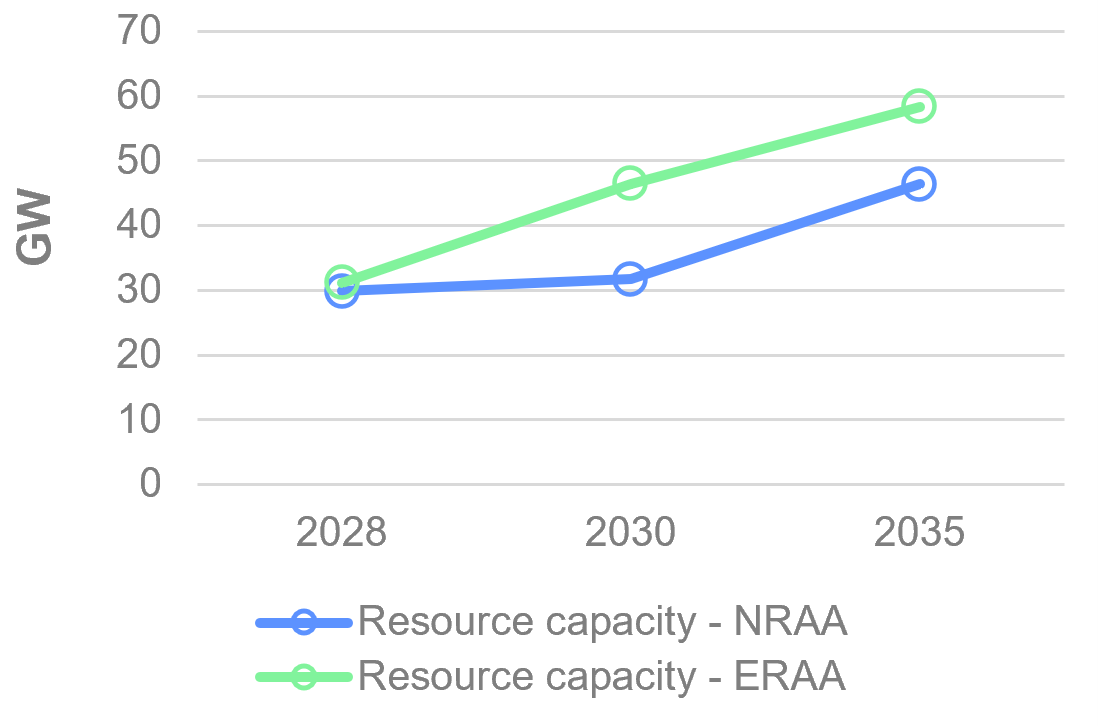
The Portuguese NRAA assumes considerably slower growth in installed electricity capacity than the ERAA 2025, with a gap of around 15 GW by 2030 and 12 GW by 2035. This is largely due to assumptions of slower wind and solar deployment in the national assessment.
Source: ACER based on the NRAA and ERAA 2025.
What are ACER’s key findings?
ACER finds that the projected resource adequacy risks are mainly driven by assumptions of strong demand growth, while new capacity, including demand-side response, is assumed to lag behind.
At the same time, the NRAA does not adequately assess how the market could respond to increasing electricity supply scarcity. Its economic viability analysis shows that existing gas-fired generation capacity would remain highly profitable, especially long-term, as tighter supply could push prices up. However, the NRAA does not examine whether these price signals could attract investments in new resources, including batteries and demand response, and offers only a limited projection of their potential contribution to security of supply.
The national assessment also overlooks cross-border factors, such as Spain’s recently approved capacity remuneration mechanism, that could affect how much electricity Portugal can import during scarcity periods.
As a result, the NRAA may overestimate Portugal’s adequacy gap by not fully accounting for resources that could realistically enter the market or be available cross‑border.
What does ACER recommend?
To strengthen Portugal’s assessment, ACER recommends:
- Applying the economic viability assessment in line with the ERAA methodology.
- Assessing the potential for new market-based investments, particularly batteries and demand response.
- Reflecting the contribution of currently ‘out-of-market' resources, such as the Tapada do Outeiro gas-fired power plant.
- Using more realistic demand response projections.
Overall, ACER considers that a robust adequacy assessment should capture new investments that could be delivered in response to market conditions, in addition to current resource development trends.
What are the next steps?
ACER encourages the Portuguese authorities to consider its feedback to improve the assessment.