Romanian adequacy assessment: Delayed energy transition affects security of supply decisions

Romanian adequacy assessment: Delayed energy transition affects security of supply decisions
What is it about?
Today, ACER published its Opinion on Romania’s National Resource Adequacy Assessment (NRAA), which complements the European Resource Adequacy Assessment (ERAA) 2025 edition.
What is a resource adequacy assessment?
The ERAA evaluates electricity resource adequacy across the EU and provides a consistent framework to assess whether additional national measures may be needed to ensure security of supply. It is carried out annually by the European Network of Transmission System Operators for Electricity (ENTSO-E) and reviewed by ACER.
Member States can complement the European analysis through national assessments (NRAAs) to reflect local conditions. When a national assessment identifies different adequacy concerns from the European assessment, ACER issues an opinion.
What did the Romanian NRAA find?
Romania’s NRAA identifies resource adequacy concerns for both 2027 and 2035 under its central reference scenario, indicating a higher risk of electricity supply shortages than the ERAA 2025 edition.
The assessment points to a slower-than-expected energy transition, driven by delays in renewable energy deployment and in the commissioning of new thermal generation capacity, along with a conservative rollout of non-fossil flexibility resources. As a result, the assessment finds that Romania’s electricity system may face resource shortages, potentially affecting the planned phase-out of coal-fired generation.
What does ACER recommend?
ACER acknowledges the rationale for adjusting capacity projections, originally based on the National Energy and Climate Plans, to better reflect recent market developments. However, long-term assumptions on generation capacity (for 2030 and 2035) should remain consistent with the projected pace of electrification.
To reinforce the assessment and provide a more robust evaluation of Romania’s resource adequacy risks, ACER recommends:
- Using the latest information on thermal generation projects. Coal phase-out assumptions should reflect current delays in the commissioning of new gas-fired power plants and the slower deployment of renewable energy. This is particularly important in the short term, as the electricity system still relies on thermal generation.
- Better reflecting the growing role of non-fossil flexibility. The assessment should capture the continued expansion of battery storage and demand response, including flexibility from data centres, across all target years up to 2035. These resources are expected to play an increasingly important role in maintaining security of supply during Romania’s energy transition, supported by emerging national policies, such as draft regulations on demand-side flexibility and the removal of double charging for electricity storage.
- Assessing the economic viability of new investments. The assessment should consider whether projected investments in flexible resources, such as demand response and storage, are commercially viable and therefore likely to be delivered. This would ensure that future flexibility needs can be met at the anticipated pace of electrification and renewables deployment.
Example: Historical and projected installed wind capacity
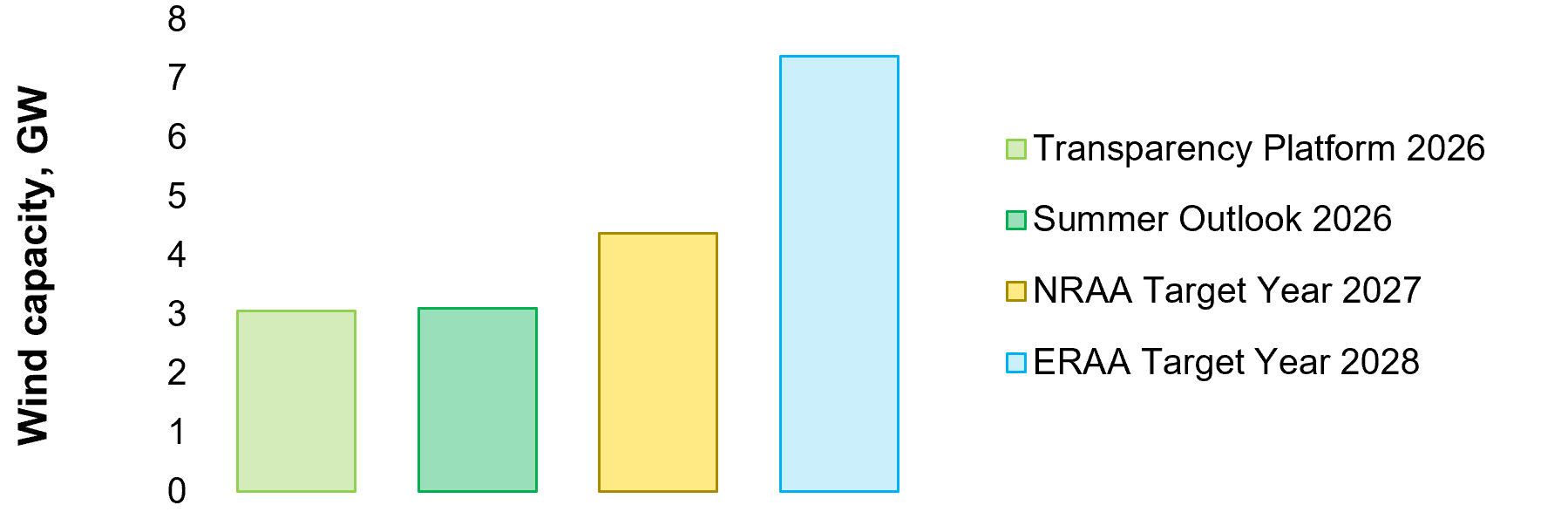
The Romanian assessment reflects a slower energy transition than the ERAA, with lower projected wind capacity in the first target year in line with recent trends, while still assuming continued growth toward national renewable energy targets.
Source: ACER based on Transparency Platform, Summer Outlook, the NRAA and ERAA 2025.
What are the next steps?
ACER encourages the Romanian authorities to:
- Consider its feedback to improve the assessment of the country’s resource adequacy risks.
- Regularly submit updated projections for realistic resource capacity and electricity demand in future ERAAs, ensuring they reflect latest market developments. This will support more realistic planning at EU level and align with the updated ERAA methodology, which includes a new ‘Trends and Projections’ scenario to capture potential deviations from National Energy and Climate Plans trajectories.