ACER has decided on the amendment of the common pricing methodology for European electricity balancing markets

Image
detail_electricity
Intro News
ACER has decided on all Transmission System Operators (TSOs)’ proposal to amend the common methodology for the pricing of balancing energy and cross-border capacity used for the exchange across the European electricity markets.

ACER has decided on the amendment of the common pricing methodology for European electricity balancing markets

What is it about?

The EU Agency for the Cooperation of Energy Regulators (ACER) has decided on the proposal by all Transmission System Operators (TSOs) to amend the common methodology for the pricing of balancing energy and cross-border capacity used for the exchange across the European electricity markets.

In particular, the amendment proposed is related to the technical price limit in the balancing timeframe.

The proposal was submitted to ACER in August 2021.

What are the benefits?

The methodology provides the common rules at European level for an efficient pricing of balancing energy, resulting from:

  • balancing energy bids activation
  • cross-border capacity used for the exchange of balancing energy.

What are the main elements of ACER’s decision?

ACER amended the TSOs’ proposal and included a transitory price limit of 15,000 €/MWh for the first 4 years of the European balancing platforms’ operations, until July 2026.

ACER understands that efficient market functioning is based on free price formation. As such, the technical price limit of 99,999 €/MWh (see ACER Decision 01/2020) has not changed.

The transitional price limit provides a safeguard for the first years of the European balancing platforms’ operations. This is a temporary measure for mitigating the possible risks of the initial phase of the European balancing platforms’ go-live and to allow TSOs and market participants to gather experience on their functioning. 

TSOs are also requested to closely follow the developments on the European platforms and report to ACER and national regulatory authorities, whenever needed.  

How did ACER contribute?

ACER has ensured that the decision is in line with the objectives of the Electricity Balancing Regulation and fulfils its legal obligations (Article 30(2)), as well as with those of the Regulation on the internal market for electricity.

In its decision, ACER also details the functioning of the European target model for the balancing markets and how this design facilitates the efficient functioning of the European internal electricity markets.

Access the ACER Decision 03/2022.

ACER to decide on ENTSO-E’s proposal on the methodology for training and certification of staff working for Regional Coordination Centres

Image
Discussing electricity
Intro News
On 18 February 2022, ACER received a proposal from ENTSO-E regarding the methodology for training and certification of staff working for Regional Coordination Centres.

ACER to decide on ENTSO-E’s proposal on the methodology for training and certification of staff working for Regional Coordination Centres

What is it about?

On 18 February 2022, the EU Agency for the Cooperation of Energy Regulators (ACER) received a proposal from the European Network of Transmission System Operators for Electricity (ENTSO-E) regarding the methodology for training and certification of staff working for Regional Coordination Centres (RCCs).

The Electricity Regulation lists the RCCs’ tasks and their roles. Among those tasks, the Regulation mandates the obligation related to the training and certification of its staff. The proposed methodology provides definitions and sets out the RCC training and certification process.

What are the next steps?

ACER will reach a decision on the proposal by 18 May 2022.

In order to inform its assessment, ACER invites interested third parties to submit their observations by 11 March 2022 to ACER-ELE-2022-004(at)acer.europa.eu.

Access the ACER Public Notice.

Access the ENTSO-E proposal and its explanatory document.

ACER decides not to approve ENTSO-E’s first pan-European resource adequacy assessment due to shortcomings

Image
Electricity pillars
Intro News
ACER published today its decision not to approve the ERAA 2021, due to significant shortcomings that compromise its accuracy and reliability.

ACER decides not to approve ENTSO-E’s first pan-European resource adequacy assessment due to shortcomings

What is it about?

In November 2021, the EU Agency for the Cooperation of Energy Regulators (ACER) received a proposal from the European Network of Transmission System Operators for Electricity (ENTSO-E) for the first pan-European resource adequacy assessment (ERAA 2021). The purpose of the assessment is to monitor the risks to Europe’s security of electricity supply and identify adequacy concerns.

​​​Following the approval by ACER of the ERAA methodology in October 2020, ENTSO-E must carry out an annual ERAA to assess whether the EU has sufficient electricity resources to meet its future demand. ERAA describes the expected level of security of supply for a ten-year horizon. A resource adequacy concern means that the expected level of risk is higher than the acceptable risk level, as defined by a Member State’s reliability standard.

In the ACER Decision published today, ACER decided to neither approve nor amend the ERAA 2021.

ERAA 2021 was not approved by ACER

While the ERAA 2021 represents a significant improvement to its predecessor (the Mid-Term Adequacy Forecast 2020), ACER has identified a number of shortcomings in the report, compromising its accuracy and reliability. ACER finds that the ERAA 2021, among other issues,

  • underestimates the level of profits that resources (e.g. generation and demand-side response) could make in the market;

  • underestimates the volume of capacity available for cross-zonal trade; and

  • does not recognise the value of demand-side response sufficiently.

ACER considers that:

  1. these shortcomings undermine the very purpose of the ERAA 2021 in providing an objective basis for identifying the risks to European security of electricity supply as envisaged in the Clean Energy Package; and

  2. the ERAA 2021 overestimates resource adequacy concerns and could lead to incorrect policy decisions with negative implications for the integration of the electricity market and higher costs to consumers.

ERAA 2021 was not amended by ACER

ACER considered amending the ERAA 2021 and concluded that it would not be feasible within the required 3-month decision-making timeframe. An amended ERAA 2021 would have limited value for identifying resource adequacy concerns, essentially for 2025 only, and be based on outdated data. Furthermore, amending the ERAA 2021 would compromise the delivery of a significantly more ambitious ERAA 2022.

The ACER decision provides recommendations for the ERAA 2022, mainly concerning the scenarios, methodology and the assumptions of the assessment (e.g. reflect the EU’s Fit for 55 proposals), and the need for extensive stakeholder engagement. The aim is to help ENTSO-E in preparing the 2022 report to mitigate the risk of similar shortcomings occurring next year and to ensure that the annual ERAAs progressively align with the requirements of the agreed methodology.

Read more on ACER’s Decision No 02/2022.

Wholesale Electricity Markets Monitoring 2021: rebound of demand, more coal, higher electricity prices and more electricity from renewables than fossil fuels

Image
Electric pillars in a forest
Intro News
ACER publishes today charts and insights on the main developments of the Electricity Wholesale Markets, as an early publication of its annual Market Monitoring Report (MMR).

Wholesale Electricity Markets Monitoring 2021: rebound of demand, more coal, higher electricity prices and more electricity from renewables than fossil fuels

Monitoring the European internal electricity markets

The EU Agency for the Cooperation of Energy Regulators (ACER) publishes today an overview of charts and insights on the main developments of the Electricity Wholesale Markets, as an early publication of its annual Market Monitoring Report (MMR).

The MMR presents the main results of monitoring the European internal electricity and gas markets and recommends further actions to foster their integration, as well as providing guidance and evidence on how energy markets can perform more efficiently.

It normally comprises three volumes analysing respectively: the Electricity Wholesale Market, the Gas Wholesale Market, and the Energy Retail Market and Consumer Protection. 

In 2022, unlike previous years, ACER will not publish a single report gathering all monitored aspects of the Wholesale Electricity Markets in 2021 but a series of brief overviews. This overview is the first of these publications.

What are the main monitoring trends in wholesale electricity markets in 2021?

  • Recovery of the electricity demand was driven by the economic recovery. This led to a series of changes in generation technologies. Coal was more used compared to 2020 to meet increased demand. As a result, generation from fossil fuels did not decrease in 2021.

Check the evolution of generation from renewable energy sources compared to fossil fuels by selecting the years 2020 and 2021 in our interactive dashboard.

Generation from renewables was above fossil fuels for the second year in a row and new renewables installed capacity kept on increasing, contributing to the energy transition.

In our dashboard, select the years 2016 - 2021, and see how the installed capacity from renewable and conventional generation technologies has changed over the years.

  • A sharp increase in coal generation took place due to the economic recovery driving demand and high gas prices, partially hampering renewables generation growth.

  • The well-known sharp increase of electricity wholesale prices in all countries contributed to reinforce coal usage and fostered a debate on consumer protection and empowerment. To different degrees, all European countries have been affected, especially those dependent on gas for a large portion of their electricity generation.

  • A constant increase of negative Day Ahead electricity prices compared to pre-pandemic values brings into focus the need for storage and demand side response, and on the importance of consumer empowerment.

See the evolution of day-ahead electricity prices and negative prices over the period 2016 to 2021 in our dashboard.

Wholesale Electricity Markets Monitoring 2021: rebound of demand, more coal, higher electricity prices and more electricity from renewables than fossil fuels

Do you want to know more?

For the full overview, access the analysis on key Electricity Wholesale Markets developments.

What were the main monitoring trends in the Gas Wholesale Markets in 2021? Find out more.

Deepen your insights (e.g. by country of interest) by interacting with the dynamic charts on electricity market trends.

ACER shares considerations on ENTSO-E’s electricity Adequacy Outlook for this winter

Image
Electricity transmission pillars in winter with snow
Intro News
ACER finds that ENTSO-E’s winter adequacy assessment is broadly consistent with its mandate and decided not to issue an opinion on it.

ACER shares considerations on ENTSO-E’s electricity Adequacy Outlook for this winter

What is it about?

The EU Agency for the Cooperation of Energy Regulators (ACER) finds that ENTSO-E’s winter adequacy assessment is broadly consistent with its mandate and decided not to issue an opinion on it.

However, given the importance of the seasonal assessments and considering the increased public attention triggered by the high energy prices, ACER shares its considerations with ENTSO-E and other stakeholders.

ENTSO-E carries out the seasonal adequacy assessments twice a year to alert Member States and transmission system operators about risks related to the security of electricity supply that potentially might occur in the following six months.

What are the main highlights of ENTSO-E Winter Adequacy Outlook?

On 1 December 2021, ENTSO-E published its Winter Adequacy Outlook 2021/2022.

In the Outlook, ENTSO-E concluded that the current surge of gas prices in Europe should not pose adequacy risks, and that overall, there is no risk to electricity security of supply this winter.

What are ACER’s considerations?

- ACER broadly agrees with ENTSO-E, that the high energy prices likely do not have a direct impact on the short-term security of electricity supply. However, this assessment is subject to adequate gas supplies in Europe.

ACER has analysed ENTSOG’s winter gas supply assessment and emphasized, in its opinion, the value of including additional scenarios based on expected gas supplies.

Because of the interlinked nature of wholesale gas and electricity prices in Europe, it is important that ENTSO-E deepens the coordination with ENTSOG to ensure that inputs and assumptions to the seasonal assessments are consistent and reflective of cross-sectoral impacts.

- ACER observes that, as part of the common European risk-preparedness framework in the electricity sector, the Outlook effectively detects possible adequacy related problems for the winter season, complementing shorter-term regional and national assessments.

In late December 2021 (after the publication of the Outlook), following an additional unplanned outage of 4.5 GW of nuclear capacity, the French transmission system operator (RTE) re-assessed the short-term adequacy of the French power system and found that cold weather combined with low wind supply could strain supply margins during January and February 2022.

ENTSO-E updated its Outlook to provide a pan-European view, confirming that the new development in the French system had no anticipated adverse impact on neighbouring countries.

ACER recommends that these events are reflected in the Winter Review 2021/2022 published along with the next seasonal assessment. Such an ex-post comparison would give meaningful insight with respect to the completeness and accuracy of the ex-ante assessment.

- Lastly, ACER believes that an opinion on the Outlook would not bring significant new information, considering its involvement in the approval and in the implementation of the underlying methodology (through prior opinions).

The Outlook represents ENTSO-E’s fourth seasonal adequacy assessment delivered on the basis of the approved methodology. ACER has supported the implementation of the methodology by following up on the previous Outlooks by issuing opinions containing a set of recommendations.

As outlined in its latest opinion, ACER expects that the next seasonal assessment (Summer Outlook 2022) will fully comply with the approved methodology.

ACER, in close coordination with ENTSO-E and the national regulatory authorities, will continue to follow potential adequacy risks manifesting in the European electricity system.

Read more.

ACER to decide on the amendment of the intraday cross-border capacity calculation methodology for the Core region

Image
Electricity Pillars
Intro News
The National Regulatory Authorities of the Core region asked ACER to decide on the first amendment of the intraday capacity calculation methodology (LT CCM) for the region.

ACER to decide on the amendment of the intraday cross-border capacity calculation methodology for the Core region

What is it about?

The National Regulatory Authorities of the Core region asked the EU Agency for the Cooperation of Energy Regulators (ACER) to decide on the first amendment of the intraday capacity calculation methodology (LT CCM) for the region.

The Core region comprises 13 countries: Austria, Belgium, Czech Republic, Croatia, France, Germany, Hungary, Luxemburg, the Netherlands, Poland, Romania, Slovakia and Slovenia.

The Core day-ahead capacity calculation methodology includes a new approach for the long- term allocation (LTA) inclusion, called Extended LTA Inclusion (ELI). The proposed amendment allows the intraday capacity calculation to accommodate the principles of ELI approach and therefore enabling the compatibility of the day-ahead and intraday capacity calculation methodologies.

What are the next steps?

The ACER’s Decision 02/2019 will be amended to enable the harmonisation of the capacity calculation principles at intraday level with the Core day-ahead capacity calculation methodology.

To take an informed decision, ACER invites interested stakeholders to submit their views by 2 March 2022 to the email: ACER-ELE-2022-002(at)acer.europa.eu.

This amendment of the intraday capacity calculation methodology is the prerequisite for the implementation of the Core Day-ahead flow-based methodology. Therefore, it needs to be completed under the fast procedure, before the Core Day-ahead flow-based market coupling (Core FB MC) will go-live (20 April 2022).

ACER expects to reach its decision by 13 April 2022, before the Core Day-ahead flow-based capacity calculation methodology would enter into force.

What are the benefits?

The cross-border capacity calculation methodology promotes effective short‐term cross‐zonal trade.

The amended intraday capacity calculation methodology for the Core region will apply the flow-based approach, fully coordinated with the day-ahead flow-based capacity calculation approach.

The amended ACER’s Decision will contribute to the effectiveness and integration of the Core electricity markets by establishing the common rules for calculating the intraday cross-zonal capacity at regional level.

ACER to decide on ENTSO-E’s proposal for the Regional Coordination Centre Post-Operation and Post-Disturbances Analysis and Reporting Methodology

Image
Electricity transmission pillars, electricity infrastructures
Intro News
On 3 January 2022, ACER received a proposal from ENTSO-E regarding the Regional Coordination Centre Post-Operation and Post-Disturbances Analysis and Reporting Methodology.

ACER to decide on ENTSO-E’s proposal for the Regional Coordination Centre Post-Operation and Post-Disturbances Analysis and Reporting Methodology

What is it about?

On 3 January 2022, the EU Agency for the Cooperation of Energy Regulators (ACER) received a proposal from the European Network of Transmission System Operators for Electricity (ENTSO-E) regarding the Regional Coordination Centre (RCC) Post-Operation and Post-Disturbances Analysis and Reporting Methodology.

The Electricity Regulation lists the RCCs’ tasks and their roles. Among those tasks, the Regulation mandates the obligation for RCCs to carry out post-operation and post-disturbances analysis. The proposed methodology describes the RCC investigation, explains the data collection process, prescribes the work of the expert panel and guides the RCCs in preparing the post-disturbances report.

What are the next steps?

ACER will reach a decision on the proposal by 3 April 2022.

In order to inform its assessment, ACER invites interested third parties to submit their observations by 31 January 2022 to ACER-ELE-2022-001(at)acer.europa.eu.

Access the ACER Public Notice.

Access the ENTSO-E’s proposal on the RCC Post-Operation and Post-Disturbances Analysis and Reporting Methodology.

ACER publishes the first Implementation Monitoring Report on the Emergency and Restoration Network Code

Image
wind
Intro News
ACER publishes today the first Implementation Monitoring Report on progress in Member States in implementing the EU-wide Network Code on Electricity Emergency and Restoration.

ACER publishes the first Implementation Monitoring Report on the Emergency and Restoration Network Code

What are the key findings?

Image
cover report

ACER publishes today the first Implementation Monitoring Report (the Report) on progress in Member States in implementing the EU-wide Network Code on Electricity Emergency and Restoration.

This Network Code provides the requirements that Transmission System Operators (TSOs) must follow in electricity emergency, blackout and restoration states. If TSOs follow these rules when they face an incident on their grid it helps prevent incidents deteriorating into blackouts and allows for an efficient and rapid restoration of the electricity system to a normal state from the emergency or blackout states.

Key Findings:

ACER finds that while implementation of the electricity grid emergency and restoration rules is well on track (e.g. on regional coordination, on suspension and restoration of market activities and on tools and facilities), there is still not a complete and uniform EU-wide implementation of this legally binding Network Code.  For example, there is still scope to improve:

  • Measures of the system defence plan that are to be implemented on the grid.

  • Measures of the restoration plans. 

  • Assessment of the costs borne by system operators subject to network tariff regulation and stemming from the obligations laid down in the Network Code.

Why is it important to follow the electricity emergency and restoration rules?

A secure and efficient operation of the EU electricity system is a task shared between all the EU.

TSOs since all national systems are, to a certain extent, interconnected and a disturbance in one control area could affect another.

Hence, ACER underlines the importance of a correctly and fully implemented Emergency and Restoration Network Code to prevent the deterioration of an incident in a national system and to avoid the spread of disturbances to other areas and to enable swift restoration of the system back to normal state after a disturbance.

Hence, ACER underlines the importance of a correctly and fully implemented Emergency and Restoration Network Code to prevent the deterioration of an incident in a national system and to avoid the spread of disturbances to other control areas and to enable swift restoration of the system back to normal state after a disturbance.

ACER Recommendations:

ACER urges a prompt implementation of the articles of the Network Code that have already entered into force and invites the relevant NRAs to ensure a timely and complete application of the provisions that will apply as of 2022.

Access the report.

ACER and ENTSO-E investigate the incident in the Polish power system on 17 May 2021

Image
Electricity pillar
Intro News
An incident which took place in Poland’s Rogowiec substation on the 17 May 2021 led to the tripping of ten generation units of the Bełchatów power plant and a loss of 3,322 MW of generation capacity.

ACER and ENTSO-E investigate the incident in the Polish power system on 17 May 2021

What is it about?

An incident which took place in Poland’s Rogowiec substation on the 17 May 2021 led to the tripping of ten generation units of the Bełchatów power plant and a loss of 3,322 MW of generation capacity.

ACER and national regulators join ENTSO-E’s Expert Panel investigating the incident.

The Expert Panel’s Final Report is expected in Quarter 1 2022.

See here the ACER-ENTSO-E joint press release (of 21 December 2021).

ACER provides Recommendation on reasoned amendments to the Capacity Allocation and Congestion Management Regulation

Image
Congestion CACM
Intro News
The EU Agency for the Cooperation of Energy Regulators (ACER) publishes today the Recommendation on the reasoned amendments to the Capacity Allocation and Congestion Management (CACM Regulation’).

ACER provides Recommendation on reasoned amendments to the Capacity Allocation and Congestion Management Regulation

What is it about?

The EU Agency for the Cooperation of Energy Regulators (ACER) publishes today the Recommendation on the reasoned amendments to the Capacity Allocation and Congestion Management (CACM Regulation’).

The CACM Regulation provides binding rules for implementing and operating an EU-wide single market coupling and capacity calculation in the day-ahead and intraday timeframes.

The process

On 22 January 2020, ACER received a request by the European Commission to provide a recommendation on reasoned amendments to the CACM Regulation.

After the scoping and drafting phase followed by a public consultation, which ended in June 2021, ACER and national regulatory authorities have evaluated all inputs received and started a review process with transmission system operators (TSOs) and nominated electricity market operators (NEMOs) to finalise the Recommendation.

On 18 January 2022 ACER is organising a webinar to present the amendments and engage with stakeholders. Register here.

 What is the Recommendation about?

The Recommendation strives to improve the entire CACM Regulation as it proposes changes to a wide range of topics, including amendments to the Electricity Transmission System Operation Regulation (‘SO Regulation’). The figure shows an overview of the proposed amendments:

Image
Proposed amendments

ACER provides Recommendation on reasoned amendments to the Capacity Allocation and Congestion Management Regulation

 What are ACER’s recommendations?

   Market coupling governance and operations

ACER proposes amendments to the current market coupling governance set-up and assignment of responsibilities to make them fit for future challenges, by:

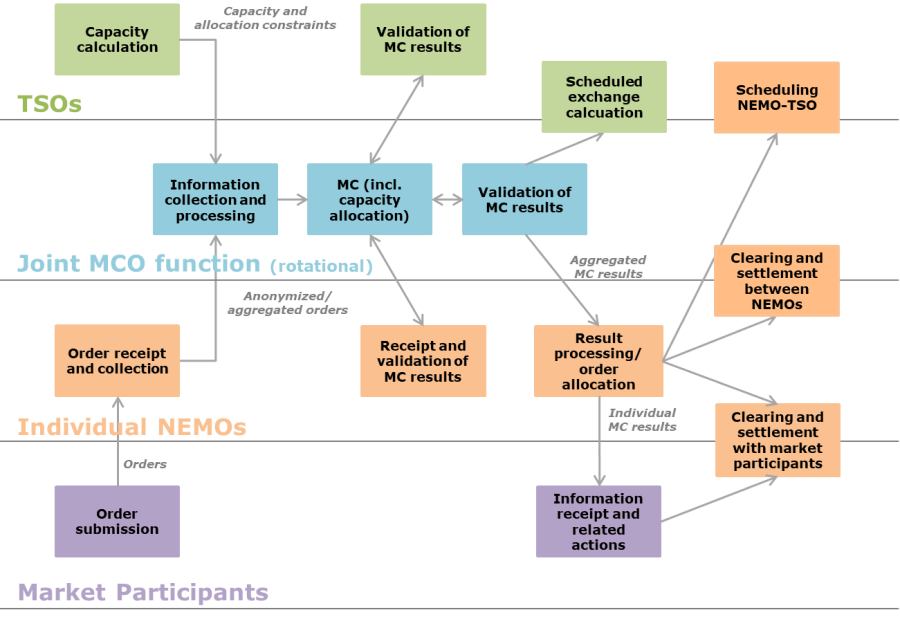
  • Introducing a joint decision making body for all TSOs and NEMOs and qualified majority voting for decisions on market coupling.

  • Establishing a European single legal entity to perform the market coupling operator’s tasks within five years after entry into force.

  • Establishing of a permanent forum to involve stakeholders and market participants in market operations.

  • The inclusion of intraday auctions as target model

  • Fostering competition between NEMOs and ensure shared order books in the intraday market until close to real time.

  • A new methodology developed by all NEMOs and TSOs on the publishing of information on the day-ahead and intraday coupling.

Image
Image 2

ACER provides Recommendation on reasoned amendments to the Capacity Allocation and Congestion Management Regulation

Capacity calculation and bidding zone review

ACER recommends to:

  • Further specify the determination of capacity calculation regions to deliver maximal cross-zonal capacity (to the physical extent possible).

  • Provide more details and regular reviews for capacity calculation methodologies to facilitate the achievement of the 70% target.

  • Align the capacity calculation processes and bidding zone review with the Electricity Regulation.

  • Improve efficiency by reformulating the criteria used in the bidding zone review.

SO Regulation

Various amendments to the SO Regulation stem out directly from the revisions of the CACM Regulation. In particular:

  • Specific content moved from the CACM Regulation to the SO Regulation will benefit of synergies in the already existing and corresponding framework of the SO Regulation.

  • Amendments mainly relate to data exchange, the common grid model, the operational security analysis and scheduling.

Would you like to find out more?

Read more on the recommendation:

All ACER recommendations can be accessed here.