ACER Workshop: Harmonised allocation rules for long-term electricity transmission rights
Online
05/09/2023 10:30
-
12:00
(Europe/Brussels)

ENTSO-E’s Summer Outlook (2023) finds no major security of electricity supply risks this summer
Image

Intro News
ENTSO-E’s seasonal outlooks provide observations and foresight for challenges associated with the security of electricity supply for winter and summer.
ENTSO-E’s Summer Outlook (2023) finds no major security of electricity supply risks this summer
What is it about?
Seasonal outlooks of the European Network of Transmission System Operators for Electricity (ENTSO-E) provide observations and foresight for challenges associated with the security of electricity supply for winter and summer. They help Member States and transmission system operators to make informed decisions related to future risks of power shortages.
The importance of these European wide seasonal assessments is heightened in the context of gas supply uncertainties, changing weather patterns and generation outages.
Highlights of ENTSO-E’s Summer Outlook (2023)
ENTSO-E’s Summer Outlook 2023 identified no electricity security of supply concerns for EU consumers. Nevertheless, close monitoring is suggested for Cyprus, Crete, Malta and Ireland.
Adequacy risks flagged for island Member States (and Crete) show the importance of interconnections in ensuring security of supply. With limited interconnections, the islands cannot benefit from the resilience the meshed network of the continental Europe offers, which allows for enhanced sharing of resources.
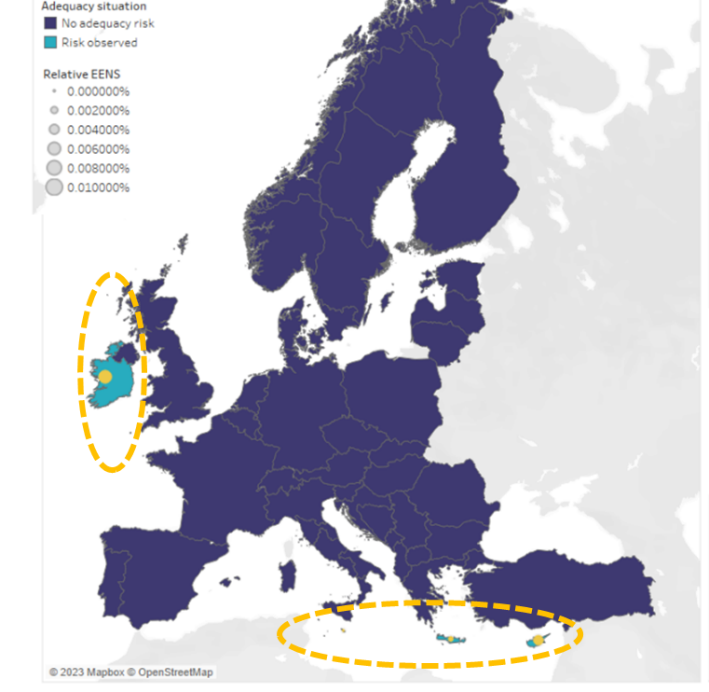
Source: ACER based on Summer Outlook 2023 - Figure 13: Adequacy risk overview - considering non-market resources
ENTSO-E’s report also points to comfortable gas storage levels by the end of summer and highlights the need to resort to any gas withdrawals with prudence over the summer period.
What does ACER say about ENTSO-E’s Summer Outlook?
- ACER appreciates ENTSO-E’s commitment to adapting its seasonal outlooks to the prevailing circumstances, such as developments in the gas system situation.
- ACER also stresses the importance of considering interconnection capacity when assessing the adequacy of electricity supply.
- ACER highlights, as in its past opinions, that ENTSO-E’s Summer Outlook assessment lacks flow-based modelling to optimise cross-zonal exchanges in line with the current market design.
For the next seasonal assessment (the Winter Outlook), ACER suggests that ENTSO-E addresses the following considerations to support management of security of electricity supply over the coming winter:
- Analyse the consequences of alternative scenarios including sensitivity to factors such as the impact of low precipitation (prolonged droughts) over the year.
- Assess the potential rebound of demand in case energy-saving measures introduced last year (2022) are not in effect and demand side response to prices is less pronounced.
Summer and Winter Outlooks
Summer and Winter Outlooks
What is it?
Image

The European Network of Transmission System Operators for Electricity (ENTSO-E) and for Gas (ENTSOG) conduct biannual assessments of potential developments in the electricity and gas systems, covering both summer and winter outlooks. ENTSO-E evaluates potential risks to the security of electricity supply in Europe, as required by the Risk Preparedness Regulation. ENTSOG analyses gas supply trends and assesses the ability of European gas infrastructure to meet demand and enable storage injections, in line with 2024 Gas and Hydrogen Regulation.
ACER may provide an opinion on the seasonal adequacy assessments produced by ENTSO-E and ENTSOG. When doing so, ACER considers the objectives of non-discrimination, effective competition, and efficient and secure functioning of the EU energy market.
Evaluation of electricity system outlooks are based on the Methodology proposed by ENTSO-E and approved by ACER Decision.
The methodology for gas infrastructure assessments is developed by ENTSOG and detailed in each seasonal outlook report.
| SEASONAL OUTLOOK | ACER'S REACTION |
|---|---|
| Summer 2026 (ENTSOG) | Communication |
| Winter 2025/2026 (ENTSOG) | Opinion No 02/2026 |
| Summer 2025 (ENTSOG) | Opinion No 06/2025 |
| Winter 2024/2025 (ENTSOG) | Opinion No 09/2024 |
| Summer 2024 (ENTSOG) | Opinion No 03/2024 |
| Winter 2023/2024 (ENTSO-E) | Communication |
| Winter 2023/2024 (ENTSOG) | Opinion No 11/2023 |
| Summer 2023 (ENTSO-E) | Communication |
| Summer 2023 (ENTSOG) | Opinion No 05/2023 |
| Winter 2022/2023 (ENTSO-E) | Opinion No 01/2023 |
| Winter 2022/2023 (ENTSOG) | Opinion No 07/2022 |
| Summer 2022 (ENTSO-E) | Communication |
| Summer 2022 (ENTSOG) | Opinion No 05/2022 |
| Winter 2021/2022 (ENTSO-E) | Communication |
| Winter 2021/2022 (ENTSOG) | Opinion No 11/2021 |
| Summer 2021 (ENTSO-E) | Opinion No 07/2021 |
| Summer 2021 (ENTSOG) | Opinion No 06/2021 |
| Winter 2020/2021 (ENTSO-E) | Opinion No 01/2021 |
| Summer 2020 (ENTSO-E) | Opinion No 07/2020 |
| Winter 2019/2020 (ENTSO-E) | Opinion No 02/2020 |
ACER monitoring shows declining gas prices due to increased LNG imports and decreasing demand
Image

Intro News
Today’s Key developments (MMR) publication provides an initial assessment of key developments in European wholesale gas markets over the recent months.
ACER monitoring shows declining gas prices due to increased LNG imports and decreasing demand
What is it about?
ACER monitors and reports annually on the EU (internal) markets of electricity and natural gas (in our so-called Market Monitoring Reports (MMR)).
In 2023, ACER publishes a series of overviews of gas markets and the progress towards an internal EU gas market. Today’s Key developments publication provides an initial assessment of key developments in European wholesale gas markets over the recent months. The analysis will be further elaborated in our September’s MMR on European gas market trends and price drivers.
What are the key findings?
Among the main trends identified in 2022 and the first half of 2023:
- The extreme wholesale gas price rises during 2022 can be primarily attributed to the Russian supply shock. However, it was the resilient demand for gas, driven upwards by above-average storage injections, that caused prices to clear at record-high levels;
- Since the end of 2022, the demand-supply balance in the gas market has improved due to a combination of rising liquified natural gas (LNG) imports and a decrease in demand, effectively compensating for the loss in Russian pipeline flows;
- This improved balance has resulted in a reduction in gas prices, which are now approaching pre-crisis levels. However, supply is overall still tight exposing prices to unexpected developments. China’s LNG demand remains an important factor for EU gas prices going forward;
- The significant price spreads between Northwest European (NWE) and South European hubs during the summer of 2022, caused by limited access to NWE, have returned to normal levels, due to increased LNG import capacity;
- Gas trading activity has increased in recent weeks due to more favourable prices and reduced margin requirements.
What are the next steps?
- September: European gas market trends and price drivers (analysing the drivers behind record-high gas prices in spring and summer 2022);
- November: 2023 Synthesis and Recommendations for gas; and
- December: Analysis of LNG market developments.
Access the Key developments in EU gas wholesale markets – 2023 Market Monitoring Report.
Dive into our interactive dashboard and explore the evolution of price and demand supply metrics for the period 2015 to 2023.

ACER workshop on unit investment costs of European energy infrastructure
ACER webinar on amendments to the European electricity grid connection network codes
ACER workshop on unit investment costs of European energy infrastructure
Online
Online
20/07/2023 10:00
-
11:30
(Europe/Brussels)

ACER webinar on amendments to the European electricity grid connection network codes
Online
Online
19/07/2023 09:30
-
11:00
(Europe/Brussels)