Summer and Winter Outlooks

Summer and Winter Outlooks

What is it?

Image
SWO

The European Network of Transmission System Operators for Electricity (ENTSO-E) and for Gas (ENTSOG) conduct biannual assessments of potential developments in the electricity and gas systems, covering both summer and winter outlooks. ENTSO-E evaluates potential risks to the security of electricity supply in Europe, as required by the Risk Preparedness Regulation. ENTSOG analyses gas supply trends and assesses the ability of European gas infrastructure to meet demand and enable storage injections, in line with 2024 Gas and Hydrogen Regulation.

ACER may provide an opinion on the seasonal adequacy assessments produced by ENTSO-E and ENTSOG. When doing so, ACER considers the objectives of non-discrimination, effective competition, and efficient and secure functioning of the EU energy market.

Evaluation of electricity system outlooks are based on the Methodology proposed by ENTSO-E and approved by ACER Decision.

The methodology for gas infrastructure assessments is developed by ENTSOG and detailed in each seasonal outlook report.

SEASONAL OUTLOOKACER'S REACTION
Summer 2026 (ENTSOG)Communication
Winter 2025/2026 (ENTSOG)Opinion No 02/2026
Summer 2025 (ENTSOG)Opinion No 06/2025
Winter 2024/2025 (ENTSOG)Opinion No 09/2024
Summer 2024 (ENTSOG)Opinion No 03/2024
Winter 2023/2024 (ENTSO-E)Communication
Winter 2023/2024 (ENTSOG)Opinion No 11/2023
Summer 2023 (ENTSO-E)Communication
Summer 2023 (ENTSOG)Opinion No 05/2023
Winter 2022/2023 (ENTSO-E)Opinion No 01/2023 
Winter 2022/2023 (ENTSOG)Opinion No 07/2022
Summer 2022 (ENTSO-E)Communication 
Summer 2022 (ENTSOG)Opinion No 05/2022
Winter 2021/2022 (ENTSO-E)Communication
Winter 2021/2022 (ENTSOG)Opinion No 11/2021
Summer 2021 (ENTSO-E)Opinion No 07/2021
Summer 2021 (ENTSOG)Opinion No 06/2021
Winter 2020/2021 (ENTSO-E)Opinion No 01/2021
Summer 2020 (ENTSO-E)Opinion No 07/2020
Winter 2019/2020 (ENTSO-E)Opinion No 02/2020

ACER will consult on its upcoming electricity cross-border capacity report

Image
electricity_cross-border_capacity_report
Intro News
From 21 July to 15 September 2023, ACER will run a public consultation on its upcoming report on cross-border capacity in EU electricity markets in 2022, to be published on 21 July 2023.

ACER will consult on its upcoming electricity cross-border capacity report

What is it about?

From 21 July to 15 September 2023, ACER will run a public consultation on its upcoming report on cross-border capacity in EU electricity markets in 2022, to be published on 21 July 2023.

What is the report about?

ACER’s monitoring is crucial for integrated markets, as it contributes to efficient cross-border trade, integration of renewables, ensuring security of supply and reducing price volatility.

The ACER report on cross-border capacity in electricity markets will:

  • Address network element usage, barriers, and potential solutions;
  • Highlight the importance of maximizing cross-zonal trading for efficiency and decarbonization; and
  • Evaluate the progress made towards the Clean Energy Package's target of achieving a minimum of 70% transmission capacity for cross-zonal trade by 2025.

What are the next steps?

After publishing its report on cross-border capacity in electricity markets on 21 July 2023, ACER will:

  • Run a public consultation to collect stakeholders’ views on the report (from 21 July to 15 September 2023); and
  • Organise a workshop to discuss the report’s conclusions (6 September 2023).

Based on its findings and stakeholders’ input, ACER will issue a formal opinion with recommendations to the European Commission and European Parliament by November 2023.

ACER will consult on the amendments to the electricity grid connection network codes

Image
Renewables
Intro News
ACER will run a Public Consultationon concrete amendment proposals on two European electricity grid connection network codes (requirements for grid connection of generators and demand connection).

ACER will consult on the amendments to the electricity grid connection network codes

What is it about?

ACER runs a public consultation from 17 July 2023 to 25 September 2023 to gather stakeholders’ views on concrete amendment proposals on two European electricity grid connection network codes:

Stakeholders can submit their comments separately, to one or both GC NCs.

The public consultation will last for 10 weeks.

Why change the rules?

Since the development of the first European grid connection codes in 2012, there have been important policy developments in decarbonising Europe’s energy and transport sectors.

The revisions of network codes are needed to update the existing regulatory framework to ensure Europe’s interconnected power system adapts to emerging trends, such as increasing number of electricity storage modules, electrical charging points for e-vehicles, or the proliferation of distributed energy resources.

What is the process of amending the rules?

In September 2022, the European Commission asked ACER to initiate the process of amending the existing European network codes. Since then, ACER has:

  • published a Policy Paper;
  • launched an initial public consultation to gather amendment proposals from stakeholders;
  • held workshops on different technical topics; and
  • developed concrete amendment proposals to the network codes for stakeholders' consultation.

On the basis of the input from this summer consultation, ACER prepared a recommendation for amendments to the European Commission later in 2023.

Access the public consultation page.

Learn more about the electricity grid connection codes.

Subscribe to receive automatic notifications on ACER’s public consultations.

ACER approves the amendments to the methodology for calculating scheduled exchanges resulting from single day-ahead coupling

Image
PC_DA Scheduled exchanges
Intro News
On 30 May 2023 ACER approved the Transmission System Operators’ (TSOs’) proposal of 20 December 2022 to amend the methodology for calculating scheduled exchanges resulting from single day-ahead coupling (SDAC).

ACER approves the amendments to the methodology for calculating scheduled exchanges resulting from single day-ahead coupling

What is it about?

On 30 May 2023, ACER approved the Transmission System Operators’ (TSOs’) proposal of 20 December 2022 to amend the methodology for calculating scheduled exchanges resulting from single day-ahead coupling (SDAC).

What is it about?

On 25 January 2023, the EU National Regulatory Authorities (NRAs) referred to ACER a joint TSOs’ proposal on the amendments to the methodology for calculating scheduled exchanges resulting from SDAC under the Capacity allocation and congestion management (CACM) Regulation.

What are the amendments about?

Having gained experience from multiple nominated electricity market operator (NEMO) arrangements, TSOs identified improvements to the methodology, particularly for calculating scheduled exchanges between NEMO trading hubs.

Before approving the TSOs’ proposal, ACER assessed whether changes would contribute to market integration, non-discrimination, effective competition and proper functioning of the EU electricity market. To make an informed decision, ACER also consulted stakeholders in March 2023.

What are the next steps?

TSOs shall implement the methodology for calculating scheduled exchanges resulting from SDAC no later than three months after its approval, i.e. by 30 August 2023.

Access the:

ACER invites experts to provide their views on the definition of structural congestion in electricity networks

Image
definition of structural congestion
Intro News
ACER invites EU electricity experts to help identify and define “structural congestion” in electricity networks.

ACER invites experts to provide their views on the definition of structural congestion in electricity networks

What is it about?

ACER invites EU electricity experts to help identify and define 'structural congestion”, in electricity networks. The Regulation on capacity allocation and congestion management (CACM) defines structural congestion in rather vague terms as congestion:

  • that can be unambiguously defined;
  • is predictable;
  • is geographically stable over time; and
  • is frequently recurring under normal power system conditions.

ACER considers that the current definition of structural congestion needs to be improved and would benefit from quantitative criteria to better identify such congestion.

Hence, ACER seeks EU electricity network experts' views on how structural congestion should be defined quantitatively and invites them to fill in a survey by 15 June 2023.

ACER grants Nordic regulators more time to agree on the amended methodology for electricity balancing

Image
NordicPowerLines
Intro News
ACER extends the deadline for the Nordic NRAs to decide on the Nordic TSOs’ proposed amendment to the market-based cross-zonal capacity allocation methodology.

ACER grants Nordic regulators more time to agree on the amended methodology for electricity balancing

What is it about?

On 19 December 2022, the national regulatory authorities (NRAs) of the Nordic Capacity Calculation Region (CCR) requested an extension to decide on the Nordic Transmission System Operators’ (TSOs’) proposed amendment to the market-based cross-zonal capacity allocation methodology.

On 14 April 2023, ACER granted an extension of six months to the Nordic CCR NRAs (Denmark, Finland, Sweden).

What is the market-based allocation process?

The market-based allocation process compares the market value of cross-zonal capacity for the electricity balancing capacity market with the forecasted market value for the day-ahead electricity market. It then allocates the capacity to the market that generates the most welfare by using the cross-zonal capacity, which:

  • allows the integration of balancing capacity markets;
  • creates welfare;
  • lowers the costs for the procurement of balancing capacity;
  • lowers the costs for tariff payers; and
  • ensures security of supply.

What are the next steps?

Nordic NRAs have until 28 June 2023 to decide on the proposal of the Nordic TSOs’ for amendment to the market-based cross-zonal capacity allocation methodology.

Access the ACER Decision 09/2023 on the extension request for Nordic CCR.

ACER’s response to ENTSO-E’s public consultation on ERAA 2023 focuses on consistency

Image
Lightbulb
Intro News
ACER did not approve the first two ERAAs submitted by ENTSO-E. The ACER decisions provided recommendations to ENTSO-E to improve their subsequent ERAA.

ACER’s response to ENTSO-E’s public consultation on ERAA 2023 focuses on consistency

What is it about?

​Each year, the European Network of Transmission System Operators for Electricity (ENTSO-E) assesses the risks to EU security of electricity supply for up to 10 years ahead with its European Resource Adequacy Assessment (ERAA). ERAA is submitted for ACER’s decision by 1 November each year.

ACER appreciates ENTSO-E`s efforts to consult on the 2023 ERAA assumptions and data. Robust results come from robust input data and stakeholder involvement is key in ensuring it.

ACER did not approve the first two ERAAs submitted by ENTSO-E (see the links to the ACER decisions on ERRA 2021 and 2022 respectively).  The ACER decisions provided recommendations to ENTSO-E to improve their subsequent ERAA.

Taking into account the experience gained in the first two years of ERAA, ACER has decided to contribute to the consultation. The aim is to transparently and concretely express ACER’s key data-related concerns to allow ENTSO-E to address them before their submission of the draft ERRA 2023 to ACER later this year. 

ACER’s key suggestions on how to improve the assessment

To improve the assessment, data input needs to be:

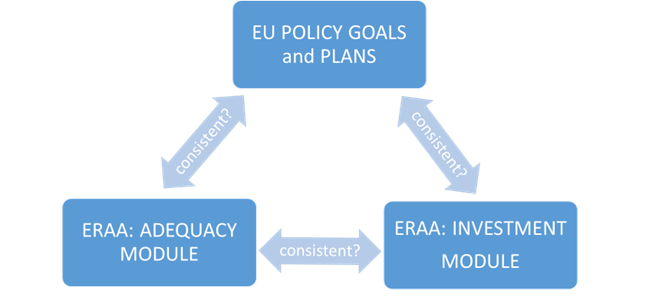
  • consistently applied within the two ERRA modules (adequacy & investment), and
  • consistent with the relevant EU and national policy goals and plans.

Figure 1: ACER’s focus is consistency of data input between ERAA modules and policy goals

ERAA modules input


Key areas of ACER’s concern

Cross-zonal capacities:

  • Cross-zonal electricity exchange represents an important adequacy resource, hence assumptions regarding cross-zonal capacities and the underlying interconnectors are crucial.
  • ACER urges ENTSO-E to consistently consider cross-zonal capacities according to the Ten-Year Network Development Plan (TYNDP) developed by the TSOs and ENTSO-E.

Climate-related assumptions:

  • Climatic variables can have a significant effect on security of electricity supply and thus on the ERAA results.
  • ACER highlights the importance of the consistent application of climatic variables across the two ERAA modules (adequacy & investment).

See ACER’s reply to ENTSO-E’s public consultation on ERAA 2023.

ACER recommends an ex-post reconciliation of the costs of electricity losses due to transits in the Inter-Transmission System Operator Compensation mechanism

Image
ITC_mechanism
Intro News
ACER publishes today its Recommendation on the treatment of electricity losses in the Inter-Transmission System Operator Compensation (ITC) mechanism.

ACER recommends an ex-post reconciliation of the costs of electricity losses due to transits in the Inter-Transmission System Operator Compensation mechanism

What is it about?

ACER publishes today its Recommendation on the treatment of electricity losses in the Inter-Transmission System Operator Compensation (ITC) mechanism.

What is the ITC mechanism?

The ITC mechanism compensates Transmission System Operators (TSOs) for the costs incurred on national power systems for hosting cross-border flows of electricity (transits). The ITC fund seeks to cover the costs of the incurred transmission losses and infrastructure’s availability.

What are power losses?

Power losses happen with electricity’s transmission and they can give rise to significant costs. In most EU countries, the procurement of energy to cover transmission losses is in the hands of the TSOs. Reducing losses decreases the operational costs of power grids and increases benefits to the society.

The ACER Recommendation is addressed to the European Network of Transmission System Operators for Electricity (ENTSO-E), TSOs and National Regulatory Authorities (NRAs) after ACER having identified potential shortcomings in its latest yearly monitoring report on the ITC mechanism.

What is the summary of ACER’s recommendations?

  • The number of snapshots used for the estimation of the volume of losses due to transits should be increased;
  • An ex-post reconciliation of the costs of losses due to transits should be applied in the ITC mechanism, to reflect the costs actually incurred; and
  • Where relevant, and at least as an interim measure, liquid forward-market prices should be considered instead of historical prices for determination of the relevant components of the value of losses for the ITC mechanism.

Access the Access the ACER Recommendation on the Treatment of Losses for the Purpose of the ITC Mechanism.

ACER consults on three proposals on electricity balancing capacity procurement

Image
Proposals on electricity balancing capacity procurement
Intro News
ACER launches a public consultation on electricity grid operators’ proposals for a harmonised cross-zonal capacity allocation methodology for procuring electricity balancing capacity.

ACER consults on three proposals on electricity balancing capacity procurement

What is it about?

ACER launches today a public consultation on electricity grid operators’ proposals for a harmonised cross-zonal capacity allocation methodology for procuring electricity balancing capacity.

Electricity grid operators must keep the power system stable or in balance. Allocating cross-zonal capacity to balancing capacity enables the power system to be balanced more efficiently.

ACER received the Transmission System Operators’ (TSOs’) and ENTSO-E’s proposals:

These three proposals aim at integrating balancing capacity markets with the use of cross-zonal capacities. The goal is to lower the costs of procuring electricity balancing capacity while ensuring security of supply. This can be archieved by reducing the overall balancing capacity needs and by lowering the procurement cost of that balancing capacity which needs to be procured.

What are the next steps?

  • ACER will assess these proposals and decide on all three by July 2023.
  • To collect the views of stakeholders, ACER is running a public consultation on the proposals from 13 April to 11 May 2023.
  • ACER invites interested stakeholders to a workshop on 19 April 2023. 

ACER amends the electricity capacity calculation regions to include Norway

Image
Electricity pylon in Norway
Intro News
ACER approved a proposal by (TSOs to include the Norwegian bidding zone borders into the electricity capacity calculation regions (CCRs).

ACER amends the electricity capacity calculation regions to include Norway

What is it about?

On 31 March 2023, with its Decision 08/2023, ACER approved for the European Union a proposal from 13 October 2022 by Transmission System Operators (TSOs) to include the Norwegian bidding zone borders into the electricity capacity calculation regions (CCRs).

What are the amendments about?

Norway is part of the internal energy market through the Agreement on the European Economic Area (EEA). In 2021, following the Capacity allocation and congestion management (CACM) Regulation becoming binding for Norway, TSOs proposed the inclusion of the Norwegian bidding zone borders in the Hansa and Nordic CCRs.

Before approving the TSOs’ proposal for the EU, ACER assessed whether the changes would contribute to market integration, non-discrimination, effective competition and the proper functioning of the EU electricity market. The EFTA Surveillance Authority (ESA) is conducting in parallel its assessment to prepare its decision for Norway.

To make an informed decision, ACER also consulted stakeholders across the EEA through a public consultation between 28 October and 25 November 2022.

What are the capacity calculation regions and why are they important?

CCRs define the geographic areas (i.e. by listing bidding zone borders) across Europe in which the task of capacity calculation and other processes are coordinated by the TSOs (i.e. subject to regional methodologies).

There are 8 CCRs in Europe: Nordic, Hansa, Core, Italy North, Greece-Italy (GRIT), South-west Europe (SWE), Baltic and South-east Europe (SEE).

Forming CCRs benefits European consumers, as it:

  • allows TSOs to run regional processes related to capacity calculation, re-dispatch and countertrading more effectively;
  • facilitates the optimal provision of cross-zonal capacity, which allows more cross-zonal trade while ensuring security of supply; and
  • further facilitates welfare increases by integrating Norwegian bidding zone borders in European and regional processes.

What are the next steps?

ESA, responsible for overseeing the application of the EEA rules in Iceland, Liechtenstein and Norway, has been asked by the Norwegian Energy Regulatory Authority for (NVE-RME) to decide on the CCR methodology for Norway.

The amendments of the CCRs decided by ACER for the EU will become applicable provided that ESA and NVE-RME adopt their respective decisions on the CCR methodology.

Access the ACER Decision on the amendment to the determination of capacity calculation regions and its annexes: