Interoperability and Data Exchange

Interoperability and Data Exchange

What is it about?

Image
gas transmission pipeline

The Interoperability and Data Exchange Rules align technical agreements and complex procedures used by network operators within the EU, facilitating the commercial and operational cooperation. The Code specifically addresses key issues in the context of interconnection agreements, units, gas quality, odourisation, and data exchange.

This harmonisation ensures efficient gas trading and transport across gas transmission systems in the European Union.

These rules can also apply to the network operators of the Energy Community and their EU neighbouring operators. The Code is applicable since 1 May 2016.

Gas transmission tariffs: ACER publishes recommendations on tariff multipliers for non-yearly products

Image
gas transmission pipeline
Intro News
ACER publishes today a Recommendation on setting the level of the multipliers used for the calculation of gas transmission tariffs applied to non-yearly capacity products.

Gas transmission tariffs: ACER publishes recommendations on tariff multipliers for non-yearly products

What is it about?

The EU Agency for the Cooperation of Energy Regulators (ACER) publishes today a Recommendation, addressed to national regulatory authorities (NRAs), on setting the level of the multipliers used for the calculation of gas transmission tariffs applied to non-yearly capacity products.

Why are multipliers relevant?

Multipliers are used to calculate the reserve prices of quarterly, monthly, daily and within-day gas capacity products, and they have an impact on network users’ booking strategies.

More specifically, the Network Code on Harmonised Transmission Tariff structures defines the level for day-ahead and within-day multipliers for standard capacity products to be between one and three. ACER carried out a public consultation in November and December 2020 to assess the possibility of setting a lower cap for multipliers for day-ahead and within-day capacity products.

What are the main recommendations?

After a careful assessment, ACER recommends NRAs to better substantiate their decisions regarding high daily and within-day multipliers, taking into account the specificities of each interconnection point and detailing their regulatory objectives (market integration, liquidity, competition, cost reflectivity and tariff stability, etc.). NRAs of Member States connected by transmission pipelines should also better coordinate their decisions when setting multipliers in combination with seasonal factors.

Access the Recommendation 01/2021.

Read more on its Annexes I and II (overview of multiplier levels & analysis and evaluation of responses).

Repurposing existing gas infrastructure to pure hydrogen: ACER finds divergent visions of the future

Image
 Hydrogen
Intro News
ACER reviewed more than 20 studies focusing on the technical and the cost aspects of repurposing existing gas infrastructure to pure hydrogen and developed a summary paper dwelling on the technical possibilities for repurposing.

Repurposing existing gas infrastructure to pure hydrogen: ACER finds divergent visions of the future

What is it about?

The European Commission’s hydrogen strategy acknowledges the potential future need for transporting hydrogen over long distances throughout Europe. Two main options are considered for connecting supply and demand by transporting hydrogen:

  • building new hydrogen-carrying pipelines or
  • repurposing existing natural gas pipelines for transporting pure hydrogen.

In order to assess these options, ACER reviewed more than 20 studies focusing on the technical and the cost aspects of repurposing existing gas infrastructure to pure hydrogen. The analysed studies range across various sources and stakeholders, including the gas industry, multi-partner hydrogen initiatives, industry partnerships, academia, think tanks, and others. As a result, ACER developed a summary paper on the technical possibilities for repurposing, based on these available studies. The paper also offers a reflection on the technical and hydrogen market conditions that could trigger the repurposing of natural gas pipelines to pure hydrogen.

What are the main findings?

  • Repurposing is feasible and cheaper than building from scratch: as a rule-of-thumb, repurposing does not present insurmountable technical challenges and is cheaper than building new pure hydrogen networks.

  • Studies also draw attention to the suitability of salt cavern facilities for storing hydrogen, noting that these facilities are geographically clustered in selected areas in a few EU Member States.

  • Ways of hydrogen transportation: similarly to natural gas, trucks and ships can also transport pure hydrogen. In all cases, distance and volume are the main drivers determining the most cost-efficient mode of transportation. However, at this time, transporting pure liquefied hydrogen by ship is not cost-efficient. Shipping hydrogen as a constituent of ammonia appears to be considerably cheaper.

  • Future pure hydrogen networks: studies offer divergent visions of the future extent of pure hydrogen networks. These visions range from a large-scale, pan-European backbone transmission infrastructure primarily based on repurposed natural gas networks, to regional, cluster-like systems handling hydrogen supply and demand in closer geographic proximity. Several studies conclude that, based on industrial hydrogen demand, technology and cost assumptions, there is no indication that a large-scale pan-European hydrogen network would be justified.

  • Repurposing to hydrogen may be conditional on:

    1. the presence of loop (parallel) lines in natural gas pipeline systems, so that at least one string could be repurposed to pure hydrogen,

    2. ensuring security of natural gas supply to consumers during the conversion phase to pure hydrogen,

    3. hydrogen market uptake in the area serving a pure hydrogen corridor.

It is uncertain when and where these conditions for repurposing would be met across Europe, and whether they will be met at all.

Following a cautious approach in the implementation phase of pure hydrogen corridors seems to be a reasonable strategy, where repurposing would be triggered by compelling hydrogen market commitments and demand expectations. 

The review is provided on a “best effort” basis and should be seen as a “live reference document”, which may need to be further updated as more knowledge about the future of hydrogen networks emerges. 

ACER and energy regulators will continue discussing the repurposing outlook and stand ready to exchange views with all stakeholders, with the goal of delivering on the decarbonisation targets, as well as ensuring cost-efficient and cost-effective solutions to the benefit of energy consumers.  

Access the Review.

First volume of the Market Monitoring Report released: the functioning of the EU internal gas market continues to improve

Image
Cover GWV MMR 2020
Intro News
Despite the unprecedented impact of COVID-19 over the economy of the EU, the functioning of the EU gas market continued to improve in 2020.

First volume of the Market Monitoring Report released: the functioning of the EU internal gas market continues to improve

What are the main findings?

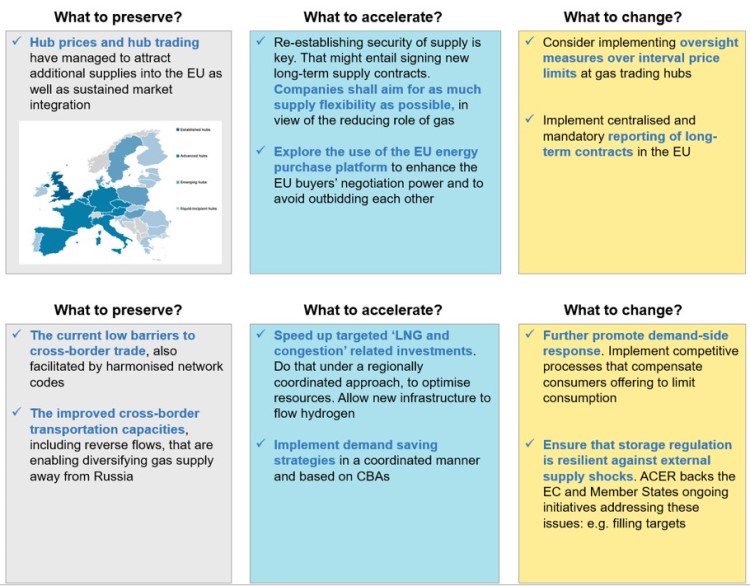
Despite the unprecedented impact of COVID-19 over the economy of the EU, the functioning of the EU gas market continued to improve in 2020. This has been evidenced by an increase in markets’ price integration and supply competition, as well as by the rise in liquidity at many gas trading hubs. Markets representing three quarters of EU gas consumption are assessed today as well functioning and sufficiently integrated. Other jurisdictions with some of the historically less developed hubs are also showing promising signs of progress.

This is one of the main conclusions of the first volume released (Gas Wholesale Volume) of the annual Market Monitoring Report (MMR) developed by the EU Agency for the Cooperation of Energy Regulators (ACER), the Council of European Energy Regulators (CEER) and the Energy Community.

With the volume on Gas Wholesale being the first to be published this year; the other two volumes, namely, Electricity Wholesale and Retail and Consumer Protection, will be released later this year. 

The Gas Wholesale Volume published today presents the results of monitoring the gas markets of the European Union and the Energy Community (a selection of neighbouring countries in Southeast Europe and the Black Sea region committed to extending the EU internal energy market). The volume assesses the progress made towards a fully functioning internal gas market. Complementarily it offers recommendations to overcome some identified barriers that can still hinder the competitiveness of selected markets or limit their market integration.

Access the Gas Wholesale Volume

Coinciding with the launching of this volume, ACER presents a series of key facts of the EU gas sector

COVID-19 together with LNG rising imports depressed prices, bolstered hub liquidity and reduced cross-border flows

The significant impact of COVID-19 on gas demand, together with the irregular import volumes of liquefied natural gas (LNG) led to a series of supply and demand rebalances throughout the year. This setting impacted on prices, market liquidity, cross-border flows and other key metrics, some of which moved to levels not seen before. 

The COVID-19 related reduction in economic activity led to a substantial decrease of gas demand in the second quarter of 2020.  That coincided with record deliveries of LNG and record-high gas stocks in underground storages in the first half of the year. All these factors, together with the reduced prices of other energy commodities, resulted in historically low EU gas hub prices in spring and early summer of 2020. However, gas demand recovered after summer, while LNG deliveries decreased substantially from the third quarter onwards because many cargoes shifted away into Asian markets. Hub prices recovered accordingly and by the end of the year, they had climbed beyond 2019 levels.

Hub traded volumes also reached historical highs increasing by 14% as market participants continuously re-adjusted their positions due to the changing supply balance and the high price volatility.

Common EU rules are bearing fruit; neighbouring countries are starting to apply them

In light of record-high price volatility, the price convergence between EU gas hubs increased compared to 2019. Amongst other reasons, abundant supply and availability of interconnection capacity smoothed regional price differences. Though full price convergence is not the aim of the Internal EU Gas Market, greater price convergence indicates that market integration is improving.

Network codes, the common EU rules intended to facilitate the harmonisation, integration and efficiency of the European gas market, are producing results. For instance, cross-border gas flows are progressively becoming more responsive to hub price signals assisted by the higher flexibility that the codes grant to transport capacity bookings. Also due to EU regulation, the balancing of gas systems has become more transparent and market based. That has also helped to improve the liquidity in some spot markets.

As of 2020, all gas network codes are also applicable in the Energy Community Contracting Parties. However, their implementation advanced only in Ukraine, generating the first beneficial effects on market integration with EU neighbouring countries. Due to some positive regulatory changes, also gas trading activity substantially increased in Ukraine.

Does gas contribute to decarbonisation?

In recent years, gas has contributed to the EU energy sector decarbonisation by replacing higher carbon emitting fuels like coal and in some instances oil in power generation. However, gas is also a significant source of greenhouse gas emissions in its own right. Therefore, conventional natural gas needs to be fully replaced by alternative energy sources or by low-carbon and renewable gases in 2050. To enable such a shift the European Commission will shortly launch a review of the gas legislative framework as part of its Fit for 55 package.

The supply share of low-carbon gas is still low in the EU even if it has doubled in the last 10 years. Low-carbon gases accounted for only 3.8% of total gas supply in 2020, chiefly in the form of biogas. This is because the cost of the currently cheapest low-carbon gas, biogas, was three to four times higher than the price of conventional natural gas at average 2020 prices. Green hydrogen produced at water electrolyser facilities with renewable power is becoming central in the EU hydrogen strategy. However, at present, it remains limited compared to future expectations, while less than 3% of commercial hydrogen supply was produced using electrolysis in 2020. A combination of market, technological and policy drivers will determine the reach of each low-carbon gas technology or alternatives in the years to come.    


Gas factsheet

Gas factsheet

Key facts about gas in the EU

  • Gas represents 21.5% of EU’s primary energy consumption. It is the dominant source of energy for households (32.1%).
  • Around 40% of households are connected to the gas network. On average, they spend EUR 700 on gas, 2.5% of their average income (EUR 27,911). However, this conceals considerable differences among Member States.
  • The average final household price for kWh of energy from gas is 6.5 cents/kWh, three times lower than from electricity (21.6 cents/kWh).
  • The EU-27 plus UK gas supply bill ranges from EUR 75-100 bn per year, depending on the wholesale sourcing price levels. At retail level, the final expenditure on gas accounts for approx. EUR 200 bn per annum.
  • The EU imports 80% of its total gas needs. Domestic production has halved in the last 10 years.
  • The residential sector accounts for most EU gas demand (40%), followed by industry and gas use for power generation. Industry consumption has declined by 20% since 2000, whereas in the same period gas use for power generation has risen by 15%. These trends are due to the EU’s economic transition from industry to energy services and structural changes in the energy-intensive industry.

Download the full set of infographics on gas facts

Image
Key facts about gas in the EU

Gas factsheet

Key attributes of gas & the internal gas market

  • The EU gas network is capable of transporting and storing large quantities of energy: it constitutes more than 200,000 km of transmission pipelines, over 2 million km of distribution network and over 20,000 compressor and pressure reduction stations.
  • The value of the total infrastructure investments is approximately EUR 65 bn in EU Transmission System Operators’ regulated asset bases. Distribution assets add to that figure at least by a factor of 3.
  • Market integration has shown its effectiveness in areas covering three-quarters of EU gas consumption. Gas price convergence is notably strong in North West Europe.
  • However, a more complete realisation of the Internal Gas Market could still bring extra benefits, chiefly to some Central and East European, South South-East and Mediterranean Member States. Sourcing gas there at the price levels attainable at most liquid North West European hubs would yield at least EUR 3 bn of benefits per year (or 20 to 40 EUR per year to individual household consumers).
  • The resilience of the EU gas system has increased significantly in recent years following regulatory initiatives (Network Codes, reverse flows, etc.) and relevant infrastructure investments that have contributed to diversify the origins of supply.
  • An efficient internal gas market based on the progression of liquid hubs is the best guarantee of the security of gas supply across the Union; the system has proved its resilience under all recent weather and political/technical situations.
Image
Gas attributes

Gas factsheet

The role of gas in a transition phase towards decarbonisation

Image
The role of gas in a transition phase towards decarbonisation
Image
Impacts on the sector in the years to come

The European Green Deal aims to fully decarbonize the gas sector by 2050

  • The gas sector accounted for a quarter of EU’s greenhouse gas emissions in 2020. Its relative share has slightly risen over the last decade as an outcome of the decrease in consumption of coal and oil and of coal to gas switches (the emissions associated to power generation at newer gas-fired plants are up to 50% lower than at newer coal-fired plants).
  • To meet the decarbonisation targets, the EU aims to shift into low-carbon gases whilst reducing its total gas consumption. A clear roadmap still needs to be approved. (Commissioner Kadri Simson: “The bloc needs to cut its gas demand by 25% by 2030”).
  • The reduction of methane leakages is also imperative. The EU aims to reduce them by 29% compared to 2005 levels by 2030.

Biogas and Hydrogen will play the leading role

  • In 2020 4% of total consumed gas in the EU-27 plus UK was low-carbon gas, chiefly biogas. Total volumes have more than doubled in the last 10 years.
  • Hydrogen has become the central element in the plans to decarbonise the sector. National Energy and Climate Plans and the European Commission strategy have committed to install 2x40 GW of electrolysers by 2030. Low carbon gases are to account for more than 15% of gas consumption by then.
  • The industry and policy makers perceive the transition as a strategic business opportunity; investments for carbon neutral gases production, additional energy generation from renewable sources and network adaptation could mobilize hundreds of billions of euros until 2050.
  • The major challenge is reducing the low carbon gas current price gap, which makes it at least three times costlier than conventional gas. Technology and scale improvements, together with a revision of carbon emissions costs are needed to make blue and green hydrogen competitive across the next decade(s).

Impacts on the sector in the years to come

  • European gas networks will require adaptation and some new investments to enable the low carbon shift. The reduction in demand could lead to some existing gas infrastructure becoming stranded.   

  • A variant presence of gas types across markets may entail some risk of market fragmentation or hinder wholesale trading if some technical aspects are not made compatible.
Image
Biogas and hydrogen will play the leading role

Gas factsheet

Gas and the COVID-19 crisis

Image
Gas and the Covid-19 crisis
  • The gas sector demonstrated its resilience during the Covid-19 crisis: EU gas consumption fell 4% YoY in 2020 while oil demand dropped by 12% and coal by circa 25%.
  • Gas prices reached historical record lows in mid-2020, amid Covid-19 impacts combined with increased Liquefied Natural Gas availability. Following the opening up of economies, prices gradually recovered from autumn 2020.

ACER-CEER organise a webinar on the key findings of the 2020 Gas Wholesale Volume of the Market Monitoring Report

Image
Ranking of EU gas hubs based on monitoring results
Intro News
The EU Agency for the Cooperation of Energy Regulators (ACER) and the Council of European Energy Regulators (CEER) will hold on 6 July a webinar to present the main findings and recommendations of the Gas Wholesale Volume of the Market Monitoring Report

ACER-CEER organise a webinar on the key findings of the 2020 Gas Wholesale Volume of the Market Monitoring Report

What is it about?

The EU Agency for the Cooperation of Energy Regulators (ACER) and the Council of European Energy Regulators (CEER) will hold on 6 July a webinar to present the main findings and recommendations of the Gas Wholesale Volume of the Market Monitoring Report (MMR) to be published on 14 July 2021.

The Volume shows that, despite the unprecedented impact of COVID-19, the functioning of the internal gas market has continued to improve in 2020: market price integration, liquidity and competition improved in 2020 compared to 2019.  Three-quarters of EU gas consumption takes place in well-functioning and integrated markets and importantly is advancing across several other jurisdictions.

The event will discuss these and many other findings on the remaining barriers identified in the report for the completion of the EU internal market for wholesale gas, the main developments in 2020 – Covid19-related and wider – and on the report’s main recommendations.

Access the Agenda and register here.

ACER and ENTSOG publish a new solution to issue raised on Gas Network Codes Functionality platform

Image
Gas Functional Platform
Intro News
ACER and ENTSOG have published a solution on the Gas Network Codes Functionality (FUNC) platform, related to the issue "Dutch TSO requirement of message PRODOC".

ACER and ENTSOG publish a new solution to issue raised on Gas Network Codes Functionality platform

What is it about?

ACER and ENTSOG have published a solution on the Gas Network Codes Functionality (FUNC) platform, related to the issue "Dutch TSO requirement of message PRODOC".

​The platform allows relevant parties to notify implementation and operational issues related to the gas Network Codes.​ The web-based platform collects the issues and facilitate cooperation among stakeholders to find relevant solutions.

In February 2020, the European Association for the Streamlining of Energy Exchange – gas (EASEE-gas)​ reported that the Dutch TSO requirement of message PRODOC is unnecessary and contrary to Network Code on Gas Balancing of Transmission. PRODOC is a document containing information about the load forecast that a balancing responsible party sends to the system operator as part of the daily balance area management process for the day ahead.

When processing the issue, ACER and ENTSOG were made aware that the use of the PRODOC message is a requirement under Dutch national law. In the issue solution, ACER and ENTSOG conclude that the review of the Dutch Energy Act is pending, and it foresees to discontinue the PRODOC requirement in the future. Since the changes in the national law remain a precondition to solve this issue and since the preparatory work for the legislative changes are ready, ACER and ENTSOG propose that the issue be solved at the national level.

The solution paper and relevant documents are available on the FUNC platform. 

​​

ACER finds serious shortcomings in ENTSOG's gas network plans – underlining the need for current TEN-E reforms to strengthen independent project assessments

Image
Gas pipeline image

ACER finds serious shortcomings in ENTSOG's gas network plans – underlining the need for current TEN-E reforms to strengthen independent project assessments

What’s the ACER Opinion on ENTSOG’s draft gas 2020 network plan about?

Every 2 years, ACER provides a non-binding opinion on the draft grid plans (called Ten-Year Network Development Plans or TYNDPs) proposed by the network operators.

In its Opinions on the draft 2020 plans, ACER finds that the electricity and gas plans (developed by ENTSO-E and ENTSOG respectively) do not sufficiently contribute to the efficient market due to several shortcomings. With respect to gas,​ in ACER's view:

  • Too many conventional gas projects - close to €75 billion – are proposed by network operators and not all are assessed by ENTSOG. Despite ongoing efforts, the framework also fails to properly assess the contribution of gas projects to sustainability.
  • The TYNDP core building blocks need to be improved such as scenarios development and cost-benefit analysis (CBA). There are also shortcomings in public consultations with stakeholders on key elements of the energy projects being proposed by network operators.
  • A number of shortcomings could be remedied by legislators in the current TEN-E reforms by strengthening the independent assessment of projects and the regulatory oversight of network operators. ACER has previously pointed to risks of lack of neutrality of the two European Networks of Transmission System Operators (ENTSOs) and the need for step changes in TEN-E governance to avoid conflict of interests while ensuring transparency.

See also the ACER Opinion on the ENTSO-E electricity network plan.​

Shortcomings could be remedied by improving the TEN-E Regulation

The EU framework for energy infrastructure needs to be robust for cost-efficient cross-border projects which are best for the energy transition.

ACER believes that the shortcomings of the TYNDP process as can be remedied by improving the TEN-E investment framework in line with the European Green Deal. To this end, regulators (ACER and CEER) issued two position papers, one in March 2021 and one in June 2020​ on how to improve the revision of TEN-E Regulation including on infrastructure development governance.

ACER has called on the European co-legislators to consider the regulators' proposals as a solution to promote a neutral technical assessment of infrastructure projects in line with the European Green Deal, avoiding risks of unjustified costs to European consumers.

For example, currently the transmission system operators (TSOs), through the European Network of Transmission System Operators (ENTSOs), develop the scenarios to assess projects in different futures. TSOs can be perceived as biased towards favouring more infrastructure as it is in their interest. The neutrality of scenarios and the credibility of the TYNDP process can thus be compromised. To safeguard neutrality, regulators have proposed the introduction of ACER framework guidelines for TYNDP scenarios for the ENTSOs to follow. This has been taken up in the European Commission's legislative proposals but should be further strengthened and streamlined, as suggested by regulators.

Europe's energy regulators have pointed to the need for strengthened regulatory scrutiny over the ENTSO's to safeguard the public interest, for ACER to be given the powers to approve the methodologies for the Cost-Benefit Analysis (CBAs) which are used to assess projects, and to issue binding guidelines to the ENTSOs for the TYNDP development.

What are ACER's key findings of the 2020 draft gas TYNDP?

ACER has issued an Opinion on the European Network of Transmission System Operators for Gas (ENTSOG) TYNDP 2020 for gas. The ACER Opinion is addressed to ENTSOG, the European Commission, the European Parliament and the Council.

ACER finds that the draft gas TYNDP 2020 follows a similar methodology as previous editions.

What are the key improvements in the 2020 draft gas TYNDP?

ACER's opinion notes limited improvements and evolution of the draft plan in comparison to previous TYNDP. Improvements are mainly limited to a better presentation of results and for the first time, the inclusion of a heterogeneous category of projects addressing the energy transition. ACER concurs with ENTSOG that current gas infrastructure in Europe is resilient, near to the completion of the internal gas market and that the limited infrastructure investment gaps will be closed in the next five years by projects already currently under development.

What are the key shortcomings of the 2020 draft gas TYNDP?

ACER regrets that the TYNDP includes a broad investment portfolio of conventional gas projects close to € 75 billion, clearly exceeding reasonable needs, in view of the lack of market appetite for developing additional transmission capacities and the decarbonisation objectives. Less than half of these are assessed by ENTSOG in the TYNDP framework. As regards the sustainability assessment of projects, although progress in observed in this TYNDP, there is room to refine it further in the future.

ENTSOG should consider ways to increase stakeholders' interest and engagement in the TYNDP development process, in view of the low number of responses (9) received during its public consultation.

ACER identifies 4 main shortcomings:

  1. Lack of proper analysis of the existing and forecasted use of gas infrastructure as critical criterion to take into account when analysing the need of additional gas infrastructure.

  2. Shortcomings in the applied methodologies, such as a lack of a complete quantitative needs assessment and doubtful quality of the cost-benefit analysis (CBA) methodology and its application which still requires improvement to demonstrate benefits exceed costs so that each individual gas project contributes to sustainability.

  3. The asymmetric treatment of candidate projects depending on whether the projects are intending to apply for Project of Common Interest (PCI) selection or not. ACER expects ENTSOG to apply project-specific cost-benefit analysis for all projects, the same way it is done for the electricity.

  4. Shortcomings in the public consultations of the scenarios methodology and the needs methodology.

In ACER's Opinion the draft gas TYNDP 2020 does not sufficiently contribute to the objectives of non-discrimination and efficient functioning of the market.

What does ACER recommend for improving future gas TYNDPs?

ACER is of the view that improvements in European infrastructure planning are feasible. ACER encourages the ENTSOs to address the remaining shortcomings and stands ready to provide guidance or clarifications where needed. ACER proposes several recommendations to ENTSOG in pursuit of an efficient, further integrated and transparent network planning at the service of consumers, decarbonisation, and sector integration ambitions:

For the Final Gas TYNDP 2020

  • Consider the National Regulatory Authority's (NRA's) comments on the TYNDP 2020 projects

  • Provide a feedback document on how the Public Consultation and ACER's Opinion have been taken into account

  • Classify the energy transition projects into gas supply/ production projects and network related investments

  • Complete information related to project CBA assessments

  • Update information on projects' status by end of year 2020

For the Gas TYNDP 2022 and beyond

  • Implement ACER's recommendations on scenarios

  • Improve planning process to avoid recurring delays, by publishing next TYNDP by mid-2022

  • Incorporate the market perspective on infrastructure gaps

  • Improve the implementation of CBA methodology

  • Include a number of “conventional" gas infrastructure projects commensurate to the assessed needs, by flagging and filtering out unrealistic projects during the data collection stage

  • Roll out modelling tools allowing for sector-integrated assessments of electricity and gas projects

  • Provide the same (maximum) level of cost transparency for all TYNDP regulated projects

  • More attention focused on adaptations of gas infrastructure for the injection of higher shares of renewable, low carbon and de-carbonised gases (hydrogen, synthetic methane, and bio-methane)

  • Together with ENTSO-E, identify suitable locations for power-to-gas installations in the system needs analysis

  • Factor the level of utilisation and congestion of existing infrastructure in the needs assessment

  • Consider ways of covering methane emissions associated with gas infrastructure

What is the TYNDP?

Every two years, ENTSOG publishes a non-binding TYNDP which looks forward over a ten-year horizon and includes a European supply adequacy outlook for natural gas. TYNDPs are essential for assessing and identifying the need of new infrastructure projects to ensure an adequate level of security of gas supply, market integration and competition. The TYNDP must be consistent with National Development Plans (NDPs) and should take into account the energy policy objective of decarbonisation under the European Green Deal.

Projects of Common Interest (PCIs) are selected from the TYNDP via a separate process led by the European Commission. The TYNDP should provide essential and comprehensive information for the selection of PCIs, in particular through complete, monetised, and reliable cost-benefit analysis (CBA) and a sustainability assessment of projects.

What is the role of ACER and its overall assessment?

ACER monitors the development and execution of the plan, and issues an opinion on the draft TYNDP taking into account the objectives of non-discrimination, effective competition, and the efficient and secure functioning of the internal gas market. ACER also looks to the alignment of the plan with broader energy transition and decarbonisation goals.

Gas tariffs reports: ACER recommends Hungary to review the storage discounts and the benchmarking adjustment

Image
Gas PCI

Gas tariffs reports: ACER recommends Hungary to review the storage discounts and the benchmarking adjustment

What is it about?

In its second report on the implementation of the EU Network Code on Harmonised Transmission Tariff Structures for Gas in Hungary, the EU Agency for the Cooperation of Energy Regulators (ACER) recommends the Hungarian national regulatory authority for Energy (MEKH) to review the discounts applied to storage points and the benchmarking adjustment applied to the entry interconnection point from Croatia.

The application of discounts to storage points is foreseen for the purpose of avoiding double charging and to acknowledge the contribution of storages to system flexibility. The benchmarking adjustment, which is also a discount, is foreseen for the purpose of levelling the tariffs for competing pipelines. Both adjustments result in an increase of tariffs at other network points, hence a cross-subsidisation effect. The Agency recommends MEKH to better assess the impact of these adjustments.

MEKH shall take a decision by 15 June 2021. 

Access the report.

Access all ACE​R reports on national tariff consultation documents.

Tariffs

Tariffs

What is it about?

ACER reports on the implementation of the Network Code on harmonised transmission tariff structures for gas​​​​. The Agency's implementation monitoring promotes a better interpretation of the EU tariff legislation's key principles concerning national practices' and their compatibility with EU rules.​

Tariffs

What are the main findings?

ACER found that transparency about the reference price methodologies has improved significantly. This suggests an improvement in the understanding of tariff setting methodologies in the EU, which may lead to more effective tariff designs in the future. Regional networks need to be better defined, as different treatments of regional networks across the EU persist. The Agency also recorded some charges unrelated to transmission activities and stressed the importance of financial neutrality.

The report also covers tariff changes and an assessment of best practices related to the allowed revenue methodologies.

Image
acer image

↓ See Also